
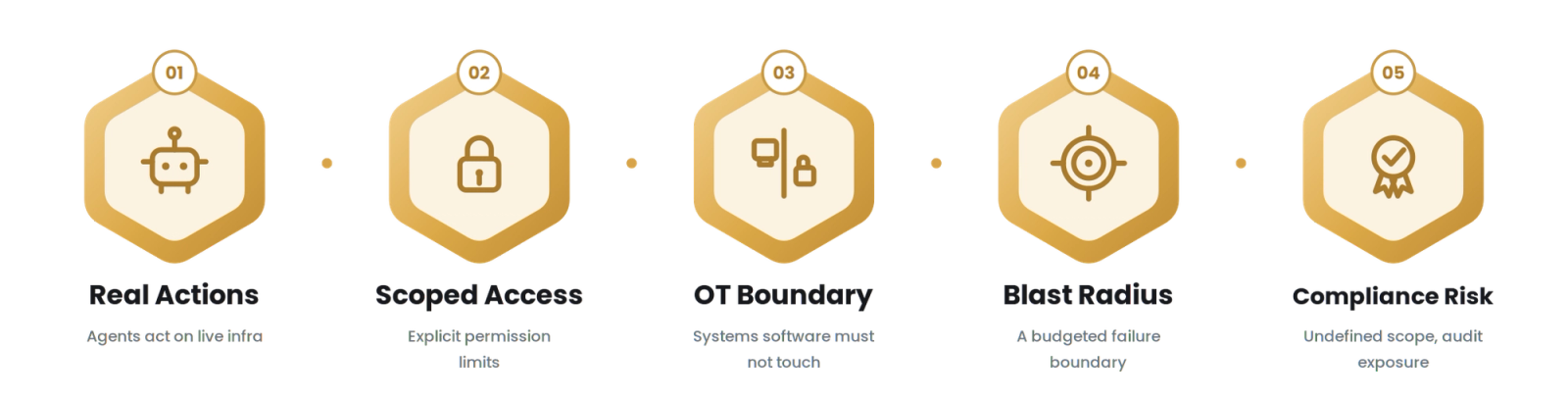
An energy company's platform team pilots an agent that can remediate infrastructure problems on its own, and the pilot goes well enough that someone quietly extends its credentials. Nobody has written down which systems it may touch, which it must never touch, or how far a wrong action can travel before a human notices.
In an org where some of that infrastructure sits one hop from operational technology and most of it falls inside a control scope an auditor will ask about, that undefined boundary is the whole risk.
The agent's reasoning is not the problem. The missing blast-radius budget is.
This is not a model question. It is a scope, permission, and blast-radius question.
AI agents for infrastructure in energy means giving AI systems the ability to take real actions on infrastructure, provisioning, remediating, scaling, reconciling, inside explicitly scoped permissions with a budgeted blast radius, so automation reduces toil without letting a wrong decision travel toward systems that must never be touched by software acting on its own.
Why Engineering Is Heading Toward Agent-to-Agent, Not Just AI-Assisted
Explore how connected agents reshape engineering beyond AI-assisted development.
However, most teams grant broad access during a pilot and define limits afterward, and in a regulated energy environment that ordering is how you end up explaining an agent action to a compliance team.
If you are a VP of Platform Engineering or Head of Developer Experience at an energy company, the intent of this article is:
- Define infrastructure agents as a scoped capability, not automation with credentials
- Show why blast radius and the OT boundary are the design constraints here
- Lay out how to grant, limit, and audit what agents actually do
To do that, let's start with the basics.
What Are AI Agents for Infrastructure in Energy? The Basic Definition
At a high level, AI agents for infrastructure in an energy org are AI systems that take real actions on your infrastructure rather than only recommending them: opening a change against a Terraform module, restarting a failing workload, scaling capacity ahead of a forecasted load event, reconciling configuration drift, or executing a documented runbook step.
What separates a useful agent from a dangerous one is not reasoning quality. It is the boundary: which systems it can reach, how large a change it can make before a human confirms, how fast a wrong action can be reversed, and whether the whole thing is loggable in a way a regulator would accept.
In energy, that boundary must also encode a hard rule: the agent stays on the IT side, always.
To compare:
An unscoped infrastructure agent in an energy org is a contractor handed master credentials on day one, acting at machine speed on systems whose regulatory classification they have never seen. A scoped agent has a job description, permissions that match it, a cap on how much it can change, and a log that explains every action.
Both look identical in a vendor demo. Only one is defensible. The scope, not the model, is what makes an agent an operational capability rather than an audit finding.
Why Are Scoped Infrastructure Agents Necessary for Energy?
Issues that it addresses or resolves:
- Agents given broad credentials during a pilot that never get narrowed
- Wrong actions traveling toward regulated or operationally adjacent systems
- No audit trail explaining what the agent did, or why it thought it was right
Resolved Issues by Scoped Agents
- Permissions matched to the agent's actual job and control scope
- Blast radius budgeted so wrong actions stay contained and reversible
- Every action logged, attributable, and explainable to an auditor
Core Components of AI Agents for Infrastructure in Energy
- Explicit scope defining what the agent may touch, and what it may never touch
- Permissions granted per task, never standing
- A blast-radius budget with hard, enforced limits
- Human gating on irreversible and regulated actions
- Full audit logging of intent, action, and outcome
Modern Infrastructure Agent Tooling for Energy
- Short-lived, scoped credentials issued per action
- Policy as code evaluating agent actions before they execute
- Change proposals through pull requests rather than direct mutation
- Volume and rate limits on how much an agent can change at once
- Observability and audit logging wired to agent actions specifically
These tools make infrastructure agents defensible in a regulated setting. Scoping permissions, budgeting blast radius, and logging intent is what turns an agent from a compliance risk into a capability an energy org can run in production.
Other Core Issues They Will Solve
- Repetitive infrastructure toil handled without a person waiting in a queue
- Changes stay compliant because agents act through approved paths
- Trust holds because every action can be explained after the fact
In Summary: AI agents for infrastructure in energy give AI real action inside explicit scope, budgeted blast radius, and full audit, so automation is fast and contained rather than fast and unexplainable in a regulated environment.
Importance of Infrastructure Agents for Energy in 2026
Agents that act on infrastructure are moving from demo to production, including in slower-moving sectors. Four reasons explain why doing this deliberately matters now.
1. Someone has already wired one up.
Agent tooling is easy to adopt and hard to see. The choice is whether it operates with a boundary or without one.
2. The OT boundary is not negotiable.
An agent that can reach operational systems is a risk you cannot explain away. The boundary has to live in permissions, not in a policy document.
3. Regulated environments demand explainability.
"The automation did it" only works as an answer if you can produce the log that shows what it did and why.
4. Speed without containment is not an advantage.
An agent making changes faster than humans is only useful if a wrong change is small and reversible.
Traditional vs. Modern Energy Infrastructure Automation
- Static scripts with fixed logic vs. agents that reason about context
- Broad standing credentials vs. short-lived scoped permissions per action
- Direct mutation of live systems vs. change proposals through reviewed paths
- Unlimited action vs. a budgeted, enforced blast radius
In summary: A modern energy approach gives agents real capability inside hard limits, so automation speeds up toil without ever pointing at systems it must not touch.
Details About the Core Components of Infrastructure Agents in Energy: What Are You Designing?
Let's go through each component.
1. Scope Layer
What the agent may touch.
Scope decisions:
- Accounts, environments, and resource types defined explicitly
- Operational technology excluded absolutely, in code
- Regulated systems flagged and treated differently
2. Permission Layer
How access is granted.
Permission decisions:
- Credentials short-lived and issued per action
- Least privilege matched to the actual task
- No standing production write access
3. Blast Radius Layer
The budget.
Blast radius decisions:
- Maximum resources changed per action capped
- Regulated systems require confirmation
- Every action has a defined rollback
4. Gating Layer
When humans decide.
Gating decisions:
- Irreversible actions always gated
- Actions inside a control scope reviewed first
- Low-risk toil allowed to run unattended
5. Audit Layer
What happened and why.
Audit decisions:
- Intent, action, and outcome logged together
- Actions attributable to a specific agent and trigger
- Logs retained and actually reviewed
Benefits Gained from Scoped Infrastructure Agents in Energy
- Routine infrastructure toil handled without a human in the loop
- Changes stay compliant because agents act through approved paths
- Incidents caused by agent error stay small, contained, and explainable
How It All Works Together
The energy platform team defines what the agent is for before granting it anything at all. Scope comes first: which accounts, which environments, which resource types, and an explicit, enforced exclusion of anything touching operational technology.
Permissions are then issued to match that scope, short-lived and per action, so the agent never holds standing write access it might reach for at the wrong moment. A blast-radius budget caps how much a single action can change, which means an agent reconciling drift touches one environment rather than every environment it can enumerate.
Actions that are irreversible, or that fall inside a control scope an auditor cares about, are gated behind human confirmation, while low-risk repetitive toil runs unattended because that is where the actual time savings come from.
Changes flow through the same reviewed paths humans use, typically a pull request against the module, rather than direct mutation of live infrastructure. Every action is logged with intent, action, and outcome together, so months later you can explain to a compliance reviewer what the agent did and what it was trying to accomplish.
Because scope, permissions, blast radius, and audit are designed as one system, the agent is fast where speed is safe and stopped where it is not.
Common Misconception
A better model makes the agent safe enough to trust with broad access.
Model quality changes how often an agent is wrong. It does not change how much damage a wrong action causes, and only the second one is under your control. An agent with excellent judgment and broad credentials in an energy org will eventually take a reasonable-looking action that turns out to be wrong for reasons it could not see, and the cost of that depends entirely on what it was allowed to reach.
An agent with average judgment and a hard blast-radius budget breaks one non-production environment and gets rolled back before anyone files a ticket. Safety comes from the boundary. Teams waiting for a model good enough to hand broad access are optimizing a variable that does not solve the problem.
Key Takeaway: Better models reduce error frequency; scope and blast-radius budgets reduce error cost. In a regulated energy environment you need the second one regardless.
Real-World Infrastructure Agents for Energy in Action
Let's take a look at how it operates with a real-world example.
We worked with an energy platform team whose pilot agent had accumulated broad credentials and no written limits, with these constraints:
- Define scope, including the OT exclusion, before granting any access
- Budget blast radius so wrong actions stay contained
- Make every agent action explainable to a compliance reviewer
Step 1: Define the Scope
What it may touch.
- Accounts, environments, and resource types listed explicitly
- Operational technology excluded in code
- Regulated systems flagged
Step 2: Issue Scoped Permissions
Least privilege.
- Short-lived credentials per action
- No standing production write access
- Permissions matched to the task
Step 3: Budget the Blast Radius
Hard limits.
- Resources changed per action capped
- Regulated systems require confirmation
- Rollback defined before execution
Step 4: Gate the Dangerous Actions
Human in the loop.
- Irreversible actions gated
- Control-scope changes reviewed
- Routine toil left unattended
Step 5: Log Everything
Intent and outcome.
- Intent, action, and outcome logged together
- Actions attributable to agent and trigger
- Logs reviewed, not just retained
Where It Works Well
- High-volume repetitive toil in IT environments with clean rollback
- Estates where scope can be expressed and enforced in code
- Teams that already run policy as code and reviewed change paths
Where It Does Not Work Well
- Anything touching or adjacent to operational technology
- Irreversible operations like data deletion or certificate cutover
- Orgs with no audit trail or no tested rollback path
Key Takeaway: Infrastructure agents work in energy where actions are scoped, reversible, and logged. They fail where credentials are broad and the boundary lives only in a document.
Common Pitfalls
i) Granting access before defining scope
Pilots start with generous credentials to see what the agent can do, and those credentials quietly become permanent. Define the job first, then grant exactly what that job needs.
- The agent can reach systems nobody intended
- Nobody can state what it is allowed to change
- The first real incident becomes a compliance conversation
ii) Treating the OT boundary as policy rather than permission
A rule that lives in a document is a rule the agent has never read. Enforce the boundary in credentials and network scope so reaching operational systems is impossible, not discouraged.
iii) Direct mutation instead of proposals
Agents that change live infrastructure directly skip every control your org built. Route changes through pull requests against modules so existing review and policy checks apply.
iv) Logging actions without intent
A log recording a deleted resource is close to useless during review. Record what the agent was trying to accomplish alongside what it did, or you cannot explain anything afterward.
Takeaway from these lessons: Infrastructure agents work when scoped, budgeted, routed through reviewed paths, and fully logged, not when handed credentials during a pilot and trusted afterward.
Infrastructure Agent Best Practices for Energy: What High-Performing Teams Do Differently
1. Write the job description before granting access
Define what the agent is for, then grant exactly the permissions that job requires, because scope defined after access is never actually enforced.
2. Enforce the OT boundary in credentials
Make it impossible for the agent to hold anything that reaches operational systems, rather than relying on instructions it may misinterpret.
3. Budget blast radius explicitly
Cap how much a single action can change and require confirmation past the cap, because containment is what makes automation safe here.
4. Route changes through reviewed paths
Have agents open pull requests against modules instead of mutating live infrastructure, so existing controls apply to agent changes too.
5. Log intent alongside action
Record what the agent was trying to do, not just what it did, because that is what turns an audit question into a two-minute answer.
Logiciel's value add is helping energy platform teams give infrastructure agents real capability inside enforced scope and budgeted blast radius, so automation reduces toil without ever pointing at systems that must stay untouched.
Takeaway for High-Performing Teams: Grant agents narrow, short-lived, well-logged access with a hard blast-radius budget, and let them run unattended only where a wrong action is cheap and reversible.
Signals You Are Doing Infrastructure Agents Well in Energy
How do you know it is working? Not by how much the agent does, but by how boring its mistakes are and how quickly you can explain them. These are the signals that separate scoped agents from audit findings.
Scope is written down. You can point to code that defines what the agent may touch.
The boundary is enforced. The agent physically cannot reach operational systems.
Wrong actions stay small. The worst incident it caused was contained and reversible.
Changes are reviewable. Agent changes flow through the same paths as human changes.
Logs explain intent. Months later you can reconstruct what the agent believed and why.
Adjacent Capabilities and Connected Work
This work does not exist in isolation. Infrastructure agents depend on, and feed into, the surrounding platform. Ignoring the adjacencies is the most common scoping mistake.
Policy as code is what evaluates whether an agent action is permitted. Your Terraform modules are what agent changes flow through. Secrets management issues the short-lived credentials. Observability tells you when the agent made things worse.
Naming these adjacencies upfront keeps the work scoped and helps leadership see agents as an operational capability rather than an unbounded experiment with credentials.
The common mistake is treating each adjacency as someone else's problem. The permission model is your problem. The rollback path is your problem. The audit log is your problem. Pretend otherwise and the first agent incident becomes a regulatory one.
Own the adjacencies you depend on, partner with the teams that hold them, and share the guardrails.
Conclusion
Infrastructure agents are reaching production in energy engineering, and the difference between a capability and a compliance problem is not model quality. It is scope, permissions, blast-radius budget, and audit. Define what the agent is for, enforce the OT boundary in credentials rather than in documentation, cap how much a single action can change, gate the irreversible and the regulated, route changes through paths that already have review, and log intent alongside action.
Do that and an agent absorbs the toil your engineers have been queuing for. Skip it and you have given machine-speed access to something that will eventually be confidently wrong in an environment that does not forgive it.
Key Takeaways:
- Agent safety comes from scope and blast-radius budget, not from a better model
- In energy, the OT boundary must be enforced in permissions, never in policy text
- Short-lived credentials, reviewed change paths, and intent logging make agents defensible
Running infrastructure agents well requires boundaries. When done correctly, it produces:
- Routine toil handled without a human in the queue
- Changes that stay compliant because agents use approved paths
- Incidents from agent error that stay small and reversible
- An audit trail that answers what happened and why
How an Energy Retailer Used Agents to Automate 40% of Customer Ops
Discover how agents automated 40% of customer operations.
What Logiciel Does Here
If your infrastructure agent picked up broad credentials during a pilot, we help you design the scope, permission model, blast-radius budget, and audit trail that make agent automation defensible in a regulated energy estate.
Learn More Here:
- Policy as Code for Agent Actions
- Terraform Module Design for Agent-Driven Change
- Secrets Management and Short-Lived Credentials
At Logiciel Solutions, we work with energy platform leaders on infrastructure automation with agents. Our reference patterns come from production deployments where agents hold real credentials in regulated environments.
Book a technical deep-dive on scoping infrastructure agents your compliance team can live with.