
An energy company has three people who can diagnose most problems in its operational estate, and two of them are within five years of retirement. AI assistance gets adopted with the hope of substituting for that expertise, and what it delivers instead is context assembly and historical retrieval, which is genuinely valuable and is not a substitute.
The knowledge those three people hold is not in any system: which alarms matter at which times of year, which substation reports offset, what the 2019 migration did to early data. No retrieval finds what was never written down.
AI cannot retrieve institutional knowledge that only exists in conversation. It can make sure it gets captured while there is still someone to ask.
AI-assisted SRE for energy means automating diagnostic context assembly and historical retrieval to reduce load on a thin expert pool, while capturing the undocumented knowledge that retrieval cannot reach and keeping everything clear of operational technology.
The State of AI-Assisted Engineering 2026: Adoption Is Basically Total
Understand near-total AI adoption and what it changes for engineering.
However, most adoptions are framed as substituting for departing expertise, which the technology cannot do and which delays the capture that would actually help.
If you are a VP of Engineering or Head of Infrastructure at an energy company, the intent of this article is:
- Define what AI assistance can and cannot substitute for
- Show why knowledge capture is the urgent adjacent work
- Lay out how to keep assistance clear of the OT boundary
To do that, let's start with the basics.
What Is AI-Assisted SRE for Energy? The Basic Definition
At a high level, AI-assisted SRE means using automation and pattern recognition to support reliability work: assembling incident context, retrieving similar past incidents, drafting timelines, and summarising for handover. In an energy estate two constraints shape it.
First, the expert pool is thin and ageing, so the value of reducing load on those people is high and the temptation to frame assistance as replacement is strong. Second, anything with action capability must be structurally unable to reach operational technology.
Retrieval quality also depends on written history, and in energy much of the relevant history was never written.
To compare:
AI assistance in this setting is a very good filing clerk arriving at an organisation where the important knowledge is held in three people's heads and the filing cabinet is thin. The clerk improves everything that is written down and cannot improve what is not.
Hiring the clerk is worth doing. Believing the clerk replaces the three people is how you lose the knowledge while feeling covered.
Why Does AI-Assisted SRE Matter for Energy?
Issues that it addresses or resolves:
- A thin expert pool carrying most diagnostic load
- Context assembly consuming the time of scarce specialists
- Institutional knowledge undocumented and approaching retirement
Resolved Issues by AI-Assisted SRE Done Well
- Mechanical context work removed from expert time
- Written history retrievable when it would help
- Capture prioritised while there is someone to ask
Core Components of AI-Assisted SRE in Energy
- Automated context assembly, read-only
- Historical retrieval over written incident records
- Deliberate knowledge capture from long-tenured staff
- The OT boundary enforced in credentials
- Judgement kept with humans explicitly
Modern AI-Assisted SRE Tooling for Energy
- Context assembly from observability and asset telemetry
- Historical incident retrieval with similarity
- Timeline and handover generation
- Structured knowledge capture workflows
- Read-only access enforced across operational sources
These tools relieve a thin pool. Structured knowledge capture is the component that addresses the actual risk, and it is the one nobody funds.
Other Core Issues They Will Solve
- Expert time spent on judgement rather than gathering
- Newer engineers responding with better context
- Undocumented knowledge moving into retrievable form
In Summary: AI-assisted SRE for energy removes mechanical load from a scarce expert pool and makes written history retrievable, while the urgent adjacent work is capturing what was never written.
Importance of AI-Assisted SRE for Energy in 2026
The expert pool is thin and shrinking while the estate is not. Four reasons explain why this matters now.
1. Diagnostic expertise is concentrated and ageing.
A small number of people hold most of the knowledge, and the timeline is not flexible.
2. Context assembly wastes scarce time.
Experts gathering dashboards are doing work that does not require their expertise.
3. Retrieval only finds what was written.
Much of the relevant history exists in conversation, which no amount of retrieval capability reaches.
4. The OT boundary is absolute.
Anything capable of acting must be structurally unable to reach operational systems.
Traditional vs. Modern Energy Reliability Practice
- Experts gather context manually vs. context assembled automatically
- History unsearchable vs. written records retrievable
- Knowledge capture deferred vs. treated as urgent
- Boundary in policy vs. enforced in credentials
In summary: A modern energy approach automates gathering, retrieves what is written, and treats capturing the rest as the priority.
Details About the Core Components of AI-Assisted SRE in Energy: What Are You Designing?
Let's go through each component.
1. Assembly Layer
Context before diagnosis.
Assembly decisions:
- Observability and asset telemetry gathered on open
- Read-only by construction
- Recent changes and dependency state included
2. Retrieval Layer
What is written.
Retrieval decisions:
- Similar incidents surfaced from written records
- Previous resolutions linked
- Gaps in history acknowledged rather than hidden
3. Capture Layer
What is not written.
Capture decisions:
- Long-tenured staff interviewed deliberately
- Capture happening during incidents
- Structured into retrievable form
4. Boundary Layer
Nothing reaching OT.
Boundary decisions:
- Read-only access to operational sources
- No action capability near OT
- Boundary enforced in credentials
5. Judgement Layer
What stays human.
Judgement decisions:
- Novel diagnosis left to people
- Suggestion constrained deliberately
- Boundary stated to responders
Benefits Gained from AI-Assisted SRE in Energy
- Expert time redirected from gathering to judgement
- Written history available under pressure
- Undocumented knowledge moving into retrievable form
How It All Works Together
The energy engineering team uses assistance to remove mechanical load from a scarce pool and treats knowledge capture as the parallel priority rather than a later phase. Context assembles automatically on incident open from observability and asset telemetry, read-only by construction and with no path toward operational technology, gathering recent changes, dependency state, and grouped alerts so an expert arrives at a judgement rather than at a gathering exercise.
Historical retrieval surfaces similar incidents from written records with previous resolutions linked, and it acknowledges where history is thin rather than presenting sparse retrieval as comprehensive. Alongside that, capture runs deliberately: long-tenured engineers are interviewed, procedures are written during and immediately after incidents, and the output is structured so retrieval can reach it later.
That capture is the work that actually addresses the retirement risk, and framing assistance as a substitute is what causes it to be deferred until the people have gone.
Common Misconception
AI assistance will help us cope when our experienced engineers retire.
It will help with the part of their work that was mechanical and will not touch the part that made them valuable. What those engineers know is which alarms matter in which conditions, which assets report unreliably, what a historical migration did to early data, and which apparently similar failures have different causes.
None of that is in a system, so no retrieval surfaces it and no model infers it. Adopting assistance and feeling covered is the specific failure, because it removes the urgency from the interviewing and documentation that would genuinely transfer the knowledge while there is still someone to ask. The assistance is worth having. It is not the mitigation.
Key Takeaway: Assistance improves what is written down. The retirement risk is everything that is not, and capture is the only mitigation.
Real-World AI-Assisted SRE for Energy in Action
Let's take a look at how it operates with a real-world example.
We worked with an energy engineering team relying on three diagnosticians, two near retirement, with these constraints:
- Remove mechanical load from the expert pool
- Treat knowledge capture as a parallel priority
- Keep everything read-only and clear of OT
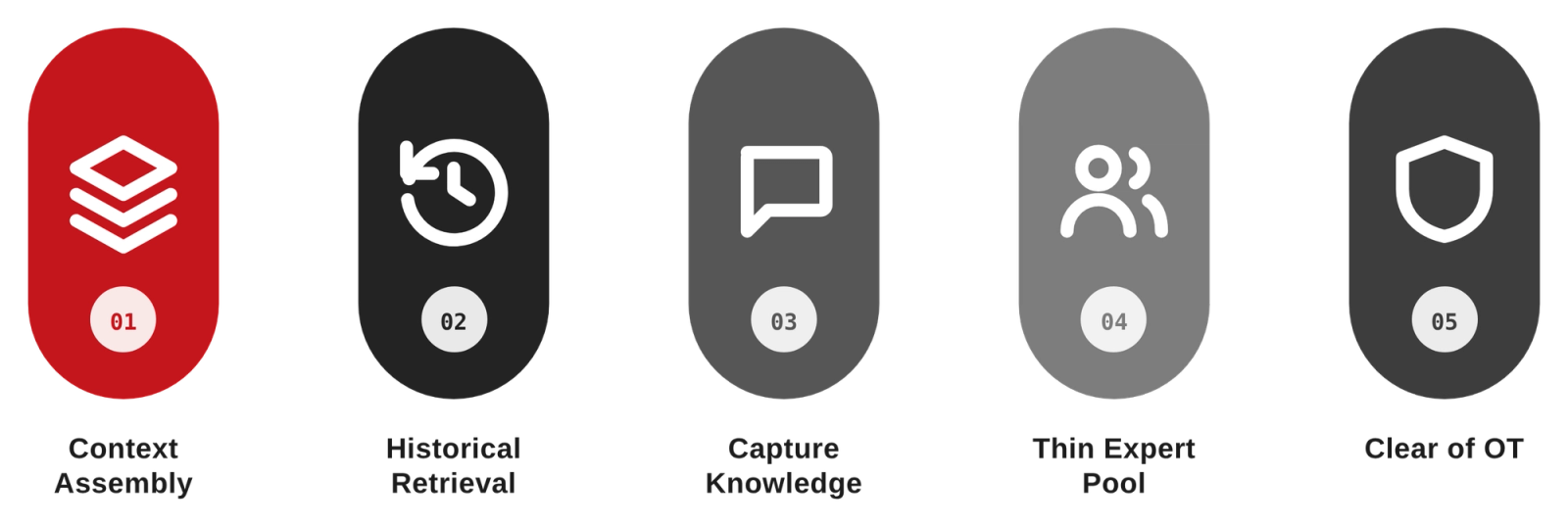
Step 1: Assemble Context Automatically
Read-only.
- Observability and asset telemetry gathered
- Recent changes and dependency state included
- No path toward operational technology
Step 2: Retrieve Written History
And admit the gaps.
- Similar incidents surfaced
- Resolutions linked
- Sparse history acknowledged
Step 3: Capture What Is Not Written
Deliberately.
- Long-tenured staff interviewed
- Procedures written during incidents
- Output structured for retrieval
Step 4: Enforce the Boundary
In credentials.
- Read-only on operational sources
- No action capability near OT
- Boundary structural
Step 5: Keep Judgement Human
Explicitly.
- Novel diagnosis with people
- Suggestion constrained
- Boundary stated to responders
Where It Works Well
- Context assembly relieving scarce expert time
- Estates with enough written history to retrieve from
- Programmes funding capture alongside assistance
Where It Does Not Work Well
- Framed as substituting for departing expertise
- Anything with action capability near operational technology
- Estates where history was never written and capture is deferred
Key Takeaway: Automate the gathering, retrieve what exists, and fund the capture that addresses the real risk.
Common Pitfalls
i) Framing assistance as succession planning
Feeling covered removes urgency from interviewing and documentation, and the knowledge leaves anyway. Fund capture explicitly and separately.
- Assistance improves the mechanical work
- The judgement knowledge departs undocumented
- The gap appears eighteen months later
ii) Presenting sparse retrieval as comprehensive
A retrieval system finding two loosely similar incidents implies coverage that does not exist. Acknowledge where history is thin.
iii) Action capability near OT
Anything capable of acting must be structurally unable to reach operational systems. Enforce it in credentials, not policy.
iv) Deferring capture until after adoption
The people holding the knowledge have a timeline. Capture is the urgent half and it gets scheduled last.
Takeaway from these lessons: The assistance is real and narrower than the framing, and the capture is what addresses the risk.
AI-Assisted SRE Best Practices for Energy: What High-Performing Teams Do Differently
1. Automate gathering to protect expert time
Let scarce diagnosticians arrive at judgement rather than spending their attention assembling dashboards.
2. Fund knowledge capture in parallel
Interview long-tenured staff deliberately and write procedures during incidents, because this is the work that transfers what matters.
3. Acknowledge thin history
Say when retrieval found little, since implied coverage is worse than admitted absence.
4. Keep everything read-only near operational sources
Enforce the boundary in credentials so assistance cannot acquire reach through configuration.
5. State the judgement boundary
Make clear what the system does not decide, so nobody treats context as conclusion.
Logiciel's value add is helping energy engineering teams use assistance to protect scarce expert time while running the knowledge capture that actually addresses the retirement risk.
Takeaway for High-Performing Teams: Automate gathering, retrieve honestly, capture urgently, enforce read-only, keep judgement human.
Signals You Are Doing AI-Assisted SRE Well in Energy
How do you know it is working? Not by assistance adoption, but by whether knowledge is moving out of people's heads. These are the signals that separate relief from false comfort.
Experts spend time judging. Gathering has moved off their plate.
Retrieval is honest. Thin history is acknowledged rather than padded.
Capture is happening. Interviews and incident documentation are producing written procedures.
Access is read-only. Nothing near operational sources can act.
The boundary is stated. Responders know what the system does not decide.
Adjacent Capabilities and Connected Work
This work does not exist in isolation. AI-assisted SRE depends on, and feeds into, the surrounding platform. Ignoring the adjacencies is the most common scoping mistake.
Runbook automation is where captured knowledge becomes executable. Observability supplies the assembled context. AIOps supplies alert correlation. Self-healing infrastructure runs proven remediations. Naming these adjacencies upfront keeps the work scoped and helps leadership see capture as the priority.
The common mistake is treating each adjacency as someone else's problem. The capture programme is your problem. The retrieval honesty is your problem. The boundary enforcement is your problem. Pretend otherwise and the assistance will be running well when the knowledge walks out.
Own the adjacencies you depend on, partner with the teams that hold them, and share the gaps.
Conclusion
AI assistance in an energy reliability practice removes mechanical load from a pool of experts too small to spend on gathering dashboards, which is a real and immediate improvement. It does not substitute for what makes those experts valuable, because the judgement they apply draws on knowledge that exists only in conversation and no retrieval reaches what was never written.
The risk in adopting it is not that it fails, it is that it produces a feeling of coverage that delays the interviewing and documentation which would genuinely transfer the knowledge. Automate the gathering, retrieve honestly, keep everything read-only and clear of operational technology, and fund the capture now.
Key Takeaways:
- Assistance improves what is documented and cannot reach what is not
- The urgent adjacent work is capturing knowledge from staff approaching retirement
- Anything with action capability must be structurally unable to reach OT
Adopting AI-assisted SRE well requires funding capture too. When done correctly, it produces:
- Expert time redirected from gathering to judgement
- Written history available under pressure
Why Engineering Is Heading Toward Agent-to-Agent, Not Just AI-Assisted
Explore how connected agents reshape engineering beyond AI-assisted development.
- Undocumented knowledge moving into retrievable form
- A boundary that assistance structurally cannot cross
What Logiciel Does Here
If AI assistance is being counted as succession planning, we help you use it to protect expert time while running the knowledge capture that actually transfers what they know.
Learn More Here:
- Runbook Automation for Energy
- AI Incident Management for Energy
- Self-Healing Infrastructure for Energy
At Logiciel Solutions, we work with energy engineering leaders on reliability practice. Our reference patterns come from estates with thin, ageing expert pools.
Book a technical deep-dive on capturing operational knowledge while there is someone to ask.