
A SaaS company's API gateway was designed around human-driven traffic: a customer clicks something, one request arrives, a person waits a second or two, and rate limits assume a browser and a bored user.
Then customers start pointing agents at the API. One agent explores endpoints methodically, issues forty calls to accomplish what a human would have done in three, retries aggressively on any error, and does all of this at a pace no person could match.
The rate limits designed for humans either throttle a legitimate customer into uselessness or let a single agent consume capacity meant for thousands. Neither outcome is acceptable, and both come from the same cause: the traffic model changed and the gateway did not.
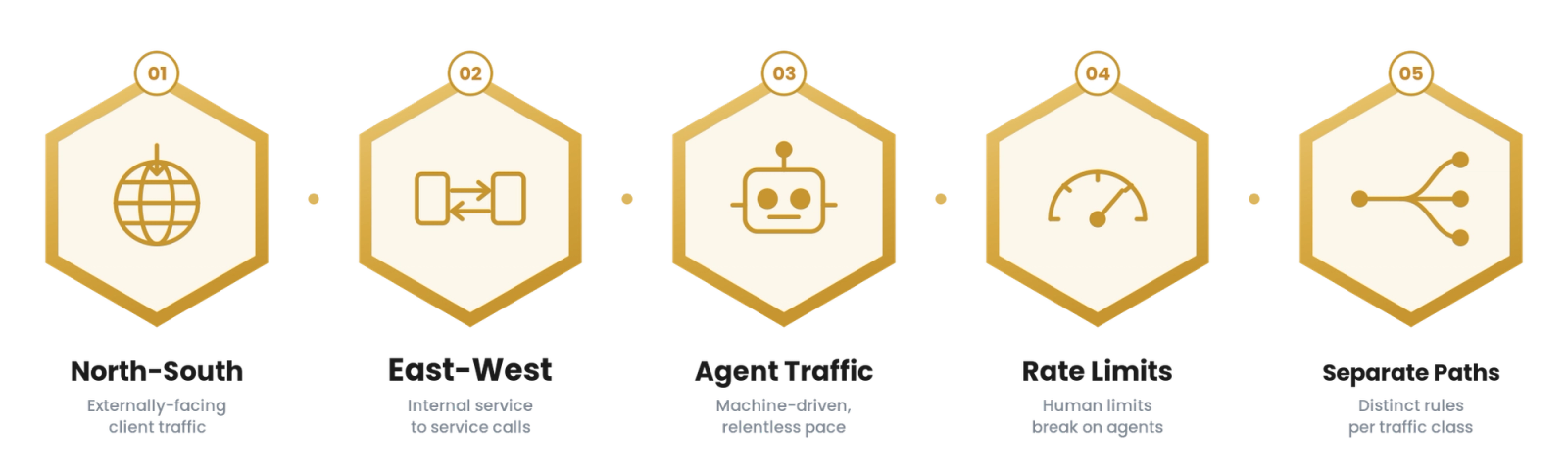
North-south, east-west, and agent traffic are three different problems. Treating them as one is why gateways fail now.
API gateway strategy for SaaS means separating externally-facing north-south traffic, internal east-west service traffic, and machine-driven agent traffic into distinct paths with their own rate limits, authentication models, and failure behavior, because they place fundamentally different demands on the same infrastructure.
Why Engineering Is Heading Toward Agent-to-Agent, Not Just AI-Assisted
Explore how connected agents reshape engineering beyond AI-assisted development.
However, most teams run one gateway with one set of assumptions inherited from a human-traffic world, and discover agent traffic breaks the limits, the retries, and the capacity model simultaneously.
If you are a VP of Platform Engineering or Head of Developer Experience at a SaaS company, the intent of this article is:
- Define the three traffic classes and why they differ
- Show how agent behavior breaks human-shaped rate limiting
- Lay out how to separate paths without running three of everything
To do that, let's start with the basics.
What Is API Gateway Strategy for SaaS? The Basic Definition
At a high level, API gateway strategy in a SaaS org is deciding how traffic enters and moves through your system, and what policy applies at each boundary. North-south traffic comes from outside: customers, partners, and their applications.
East-west traffic moves between your own services, where latency budgets are tight and a gateway hop is often pure cost. Agent traffic is externally-originated but machine-driven, and it behaves differently from both: bursty, exploratory, retry-heavy, and indifferent to the response times humans tolerate.
The strategy question is which policies apply where, and the mistake is assuming one gateway with one configuration can serve all three well.
To compare:
A gateway built for human traffic is a shop with one door, one till, and staffing based on how fast people walk. Agent traffic is a delivery service that sends someone to check every shelf, twice, in ninety seconds, then returns immediately when told the shop is busy.
Nothing about the shop is broken. The assumptions about who walks through the door are. You do not fix that by making the door narrower, because that also stops the customers.
Why Is Deliberate Gateway Strategy Necessary for SaaS?
Issues that it addresses or resolves:
- Rate limits designed for humans throttling legitimate agent use
- A single agent consuming capacity intended for many customers
- East-west traffic paying gateway latency it does not need
Resolved Issues by Separating Traffic Classes
- Limits shaped to actual client behavior rather than to a human model
- Agent traffic contained without blocking legitimate automation
- Internal service calls taking the shortest reasonable path
Core Components of API Gateway Strategy in SaaS
- Distinct paths for north-south, east-west, and agent traffic
- Rate limiting shaped per class and per tenant
- Authentication that identifies agents distinctly from users
- Retry and backoff behavior enforced at the boundary
- Observability that separates the classes in every metric
Modern API Gateway Tooling for SaaS
- Gateways supporting per-tenant and per-class rate limiting
- Service mesh handling east-west policy without a gateway hop
- Token-based identity that distinguishes agents from human sessions
- Cost-aware quotas for expensive endpoints
- Traffic analytics that separate machine from human patterns
These tools make gateway strategy work at scale. Being able to identify what kind of client is calling, and applying different policy accordingly, is what keeps agent traffic from being either blocked or unlimited.
Other Core Issues They Will Solve
- Capacity planning that reflects real traffic mix
- Abuse contained without penalising legitimate automation
- Internal latency budgets protected from unnecessary hops
In Summary: API gateway strategy for SaaSseparates north-south, east-west, and agent traffic into paths with their own limits and failure behavior, because the assumptions that fit human traffic do not survive machine clients.
Importance of Gateway Strategy for SaaS in 2026
The client population changed faster than most API designs did. Four reasons explain why this matters now.
1. Agents are now a normal client type.
Customers are pointing automation at your API whether or not you planned for it, and that share is growing.
2. Human-shaped rate limits fail both ways.
The same limit either throttles legitimate agents into uselessness or lets one consume a tenant's entire budget.
3. Retry behavior amplifies incidents.
Agents retry harder and faster than humans, so a brief degradation becomes a self-inflicted load spike.
4. Expensive endpoints need cost-aware limits.
When one call runs an expensive query and an agent issues forty, request-count limits stop reflecting actual cost.
Traditional vs. Modern SaaS Gateway Design
- One gateway for everything vs. separate paths per traffic class
- Request-count limits vs. cost-aware quotas on expensive endpoints
- Agents indistinguishable from users vs. identity that names the client type
- Retries left to clients vs. backoff enforced at the boundary
In summary: A modern SaaS approach shapes policy to client behavior, separating agent and internal traffic from the human-facing path rather than forcing one configuration to fit all three.
Details About the Core Components of Gateway Strategy in SaaS: What Are You Designing?
Let's go through each component.
1. North-South Layer
External human-driven traffic.
North-south decisions:
- Limits shaped to interactive use patterns
- Authentication tied to user sessions
- Latency budgets set by human expectation
2. East-West Layer
Internal service traffic.
East-west decisions:
- Gateway hops avoided where a mesh suffices
- Policy applied without adding latency
- Failure handling tuned for tight budgets
3. Agent Layer
Machine-driven external traffic.
Agent decisions:
- Agents identified distinctly at authentication
- Limits shaped to bursty exploratory patterns
- Backoff enforced rather than requested
4. Cost Layer
Expensive operations.
Cost decisions:
- Quotas weighted by actual resource cost
- Expensive endpoints limited separately
- Per-tenant budgets rather than global ones
5. Observability Layer
Seeing the mix.
Observability decisions:
- Metrics separated by traffic class
- Agent share tracked over time
- Retry storms visible before they escalate
Benefits Gained from Deliberate Gateway Strategy in SaaS
- Legitimate agent use supported without unbounded consumption
- Internal latency protected from unnecessary gateway hops
- Capacity planning based on the real client mix
How It All Works Together
The SaaS platform team stops treating the gateway as one policy surface and starts treating it as three. External human-driven traffic keeps limits shaped to interactive use, where a person clicks, waits, and gives up if it takes too long.
Internal service traffic moves to a mesh where policy is applied without a gateway hop, because adding fifteen milliseconds to every internal call to enforce a rule the service could enforce itself is a poor trade at scale.
Agent traffic gets its own treatment, which starts with being able to identify it: tokens issued to automation are distinguishable from user sessions, so the gateway knows what kind of client is calling before deciding what to allow.
Agent limits are shaped to bursty exploratory behavior rather than steady interactive use, with backoff enforced at the boundary rather than politely requested in a header that automation ignores. Quotas on expensive endpoints are weighted by real resource cost, since forty cheap calls and forty expensive ones are the same number and wildly different loads.
Everything is measured with traffic class as a first-class dimension, so a retry storm is visible as a retry storm rather than as a general traffic increase, and the growing agent share informs capacity planning rather than surprising it.
Common Misconception
Agent traffic is just more traffic, so we need more capacity.
Volume is the least interesting property of agent traffic, and buying capacity to absorb it treats a shape problem as a size problem. Agents behave differently in ways that matter more than their request count.
They explore rather than following known paths, so they hit endpoints your caching strategy never anticipated. They retry immediately and persistently, which turns a two-second degradation into a load spike that extends the degradation.
They have no patience threshold, so the natural back-pressure of humans giving up disappears entirely. And they can be pointed at an API by a customer who has no idea how expensive a particular call is on your side.
More capacity absorbs a busy day. It does not fix limits that assume a human is waiting, or retry behavior that amplifies every incident you have.
Key Takeaway: Agent traffic is a different shape, not a bigger volume. Capacity does not fix limits and retries built for humans.
Real-World Gateway Strategy for SaaS in Action
Let's take a look at how it operates with a real-world example.
We worked with a SaaS platform team whose human-shaped rate limits were both throttling customers and failing to contain agents, with these constraints:
- Separate traffic classes with distinct policy
- Identify agent clients at authentication
- Make limits reflect cost rather than request count
Step 1: Separate the Classes
Three problems, not one.
- North-south, east-west, and agent paths defined
- Policy shaped per class
- Internal traffic moved off the gateway hop
Step 2: Identify the Clients
Know who is calling.
- Agent tokens distinguishable from user sessions
- Client type available at policy decision time
- Tenant identity carried through
Step 3: Shape the Limits
Behavior, not averages.
- Bursty exploratory patterns accommodated
- Per-tenant budgets enforced
- Global limits kept as a backstop
Step 4: Enforce Backoff
Not a suggestion.
- Backoff applied at the boundary
- Retry storms damped automatically
- Degradation prevented from amplifying
Step 5: Measure by Class
See the mix.
- Metrics separated by traffic class
- Agent share tracked over time
- Retry patterns visible early
Where It Works Well
- APIs with a growing share of machine-driven clients
- Orgs able to distinguish client types at authentication
- Teams with per-tenant quota infrastructure already in place
Where It Does Not Work Well
- Gateways that cannot tell agents from user sessions
- Request-count limits on endpoints with wildly varying cost
- Internal traffic forced through an external gateway for policy
Key Takeaway: Separate the classes, identify the client, and shape limits to behavior and cost rather than to a request count designed for humans.
Common Pitfalls
i) One rate limit for all clients
A limit tuned for interactive human use either throttles legitimate agents or lets one consume a tenant's whole budget. Shape limits per class and per tenant instead.
- Legitimate automation becomes unusable
- A single agent starves other customers
- Support tickets blame the API for both outcomes
ii) Requesting backoff instead of enforcing it
Retry-After headers are advisory, and automation frequently ignores them. Enforce backoff at the boundary so a degradation cannot be amplified by client retries.
iii) Counting requests instead of cost
Forty cheap calls and forty expensive ones look identical to a request counter. Weight quotas by real resource cost so limits track load rather than call volume.
iv) Routing internal traffic through the external gateway
Adding a gateway hop to every internal call to apply policy is a latency tax you pay forever. Use a mesh for east-west policy and keep the gateway for the boundary.
Takeaway from these lessons: Gateway strategy works when policy matches client behavior and cost, and fails when one human-shaped configuration serves everything.
Gateway Strategy Best Practices for SaaS: What High-Performing Teams Do Differently
1. Separate the three traffic classes
Give north-south, east-west, and agent traffic distinct paths and policy, because they make incompatible demands on the same infrastructure.
2. Identify client type at authentication
Issue tokens that distinguish automation from user sessions, since you cannot apply different policy to a client you cannot recognise.
3. Weight quotas by cost
Limit expensive endpoints separately and weight budgets by real resource consumption, because request counts stop meaning anything when call costs vary widely.
4. Enforce backoff at the boundary
Damp retry storms in the gateway rather than trusting clients to honour headers, so a short degradation cannot become a long one.
5. Measure by traffic class
Make client type a first-class dimension in every metric, so you can see the agent share growing before it changes your capacity requirements unexpectedly.
Logiciel's value add is helping SaaS platform teams separate traffic classes and reshape gateway policy around machine client behavior, so agent traffic is supported rather than either blocked or unbounded.
Takeaway for High-Performing Teams: Treat agents as a distinct client class with their own identity, limits, and enforced backoff, and keep internal traffic off the external gateway path.
Signals You Are Doing Gateway Strategy Well in SaaS
How do you know it is working? Not by how few incidents you had, but by whether agent traffic is a normal operating condition. These are the signals that separate a deliberate design from an inherited one.
Client types are distinguishable. The gateway knows whether a caller is automation or a user session.
Limits reflect cost. Expensive endpoints have their own budgets.
Backoff is enforced. Retry storms damp automatically rather than amplifying.
Internal calls skip the gateway. East-west policy is applied without an extra hop.
Metrics separate classes. You can see agent share and its trend at any time.
Adjacent Capabilities and Connected Work
This work does not exist in isolation. Gateway strategy depends on, and feeds into, the surrounding platform. Ignoring the adjacencies is the most common scoping mistake.
Your service mesh handles east-west policy the gateway should not. Identity and token issuance determine whether client types are distinguishable. Observability tells you what the traffic mix actually is. Capacity planning consumes those numbers.
Naming these adjacencies upfront keeps the work scoped and helps leadership see gateway strategy as a traffic design decision rather than a product selection.
The common mistake is treating each adjacency as someone else's problem. The client identity model is your problem. The retry behavior is your problem. The cost weighting is your problem. Pretend otherwise and one customer's agent will eventually consume a tenant's entire budget while your dashboard shows normal request volume.
Own the adjacencies you depend on, partner with the teams that hold them, and share the limits.
Conclusion
The client population changed and most API gateways did not. North-south traffic from humans, east-west traffic between your services, and agent traffic from customer automation are three different problems with different limits, different failure behavior, and different latency expectations.
Identify client type at authentication so you can apply different policy. Weight quotas by cost rather than request count. Enforce backoff at the boundary instead of asking politely. Keep internal traffic off the external gateway path.
Do that and agent traffic becomes a normal operating condition. Ignore it and you will keep choosing between throttling your customers and letting one of them consume everything.
Key Takeaways:
- North-south, east-west, and agent traffic need distinct policy and paths
- Agent traffic is a different shape, not simply a larger volume
- Request-count limits stop meaning anything when endpoint costs vary
Getting gateway strategy right requires shaping policy to behavior. When done correctly, it produces:
- Legitimate automation supported without unbounded consumption
- Retry storms damped before they extend an incident
- Internal latency protected from unnecessary hops
- Capacity planning based on the real client mix
An API Review Template Built for a World Where Agents Are Your Caller
Review APIs for agent callers before ambiguity becomes an integration risk.
What Logiciel Does Here
If your rate limits are throttling customers and failing to contain agents at the same time, we help you separate traffic classes and reshape policy around machine client behavior.
Learn More Here:
- Service Mesh in 2026 for Technology & SaaS
- Multi-Region Architecture and Traffic Design
- Platform Engineering for Technology & SaaS
At Logiciel Solutions, we work with SaaS platform leaders on API traffic architecture. Our reference patterns come from gateways handling significant machine-driven load.
Book a technical deep-dive on reshaping your gateway for agent traffic.