
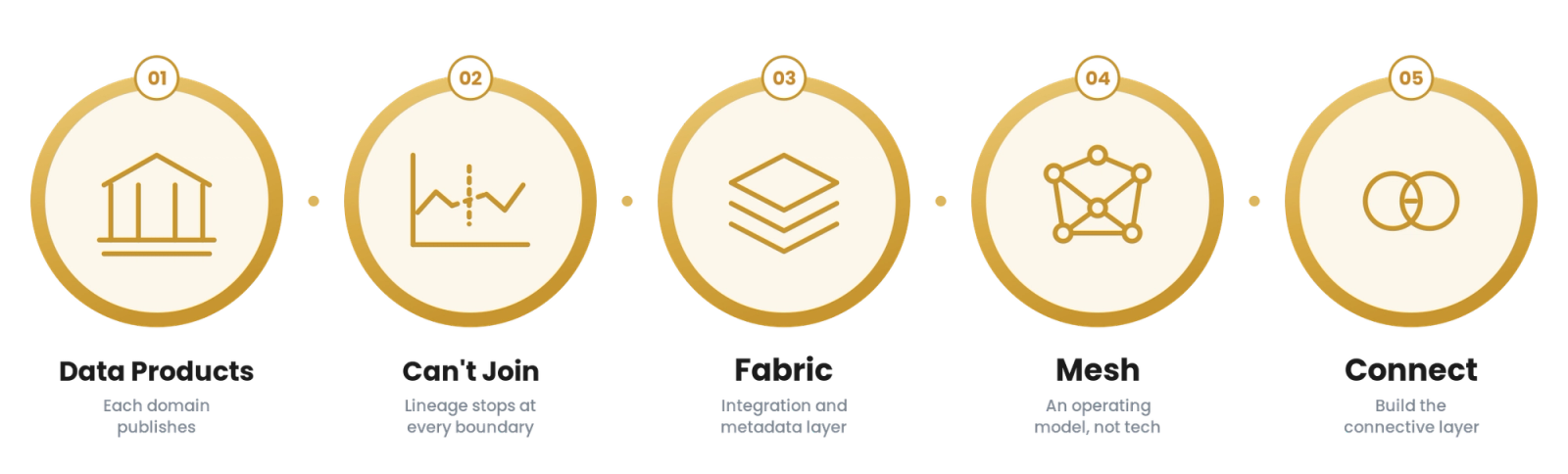
A SaaS company adopts data mesh, and it goes reasonably well, because thirty product teams already have engineers and domain ownership is a natural fit. Each domain publishes data products. Eighteen months later the complaint is not that products do not exist but that nobody can join them: three teams define an active account differently, lineage stops at each domain boundary, and answering a question that spans product usage, billing, and support requires a human to reconcile four sources by hand.
The mesh worked. The connective layer nobody built is now the constraint, and it was always going to be, because distributing production does not distribute integration.
Fabric is architecture. Mesh is an operating model. SaaS orgs usually have the second and are missing the first.
Data fabric for SaaS means an integration and metadata layer connecting distributed data products with unified discovery, lineage, and governance, whereas data mesh is an organisational model distributing data ownership to domains, so the first is a technical investment and the second a staffing decision.
Why Engineering Is Heading Toward Agent-to-Agent, Not Just AI-Assisted
Explore how connected agents reshape engineering beyond AI-assisted development.
However, most SaaS orgs adopt mesh successfully, skip the connective layer, and discover that thirty well-owned data products that cannot be joined is a different problem rather than a solved one.
If you are a CDO or VP of Data at a SaaS company, the intent of this guide is:
- Define fabric and mesh as architecture and operating model respectively
- Show why mesh success creates the integration problem rather than solving it
- Lay out how to build the connective layer without recentralising ownership
To do that, let's start with the basics.
What Is Data Fabric for SaaS? The Basic Definition
At a high level, a data fabric is a technical layer that connects distributed data sources and products so consumers get unified discovery, consistent metadata, cross-domain lineage, and governance regardless of which team produced what.
It is architecture: designed and built, working independently of how ownership is organised. Data mesh is an operating model distributing ownership of data products to the domains that generate them. In a multi-team SaaS org the mesh half is comparatively easy, because product teams already have engineers and already own their services.
The hard part is that thirty independently owned data products need shared identity resolution, shared definitions, and lineage that crosses domain boundaries, and none of that emerges from ownership.
To compare:
A mesh is the decision that each district maintains its own fleet, which works well when districts are competent. A fabric is the road network connecting them with consistent signage. Distribute the fleet across thirty capable districts and you get thirty well-maintained fleets that cannot reach each other, which is a very specific kind of achievement.
Most SaaS data programmes get the fleet right and then spend a year discovering that signage was the actual product.
Why Does This Distinction Matter for SaaS?
Issues that it addresses or resolves:
- Domain data products that cannot be joined across teams
- Core entities like account or user defined differently per domain
- Lineage stopping at each domain boundary
Resolved Issues by Building the Fabric
- Cross-domain discovery and querying without recentralising ownership
- Shared definitions for entities every domain references
- Lineage tracing a figure across multiple domains
Core Components of Data Fabric in SaaS
- Connectivity across domain-owned data products and source systems
- A metadata layer spanning every domain, populated automatically
- Cross-domain lineage rather than per-domain lineage
- Shared identity resolution for core entities
- Governance and access policy applied consistently
Modern Data Fabric Tooling for SaaS
- Catalogs harvesting metadata from every domain automatically
- Cross-system lineage tracking spanning domain boundaries
- Federated query avoiding forced replication between domains
- Policy-based access control evaluated centrally
- Contract registries making domain interfaces discoverable
These tools make a mesh joinable. Cross-domain lineage and shared identity resolution are what turn thirty independent products into an estate rather than a collection.
Other Core Issues They Will Solve
- Analysts answer cross-domain questions without manual reconciliation
- Core entity definitions stop diverging silently
- Governance stays consistent as ownership distributes
In Summary: Data fabric for SaaSis the connective layer that makes distributed data products joinable, discoverable, and traceable, while mesh is the separate decision about who produces them.
Importance of This Distinction for SaaS in 2026
Multi-team SaaS orgs adopted mesh early and are now hitting its second-order problems. Four reasons explain why this matters now.
1. Mesh succeeded, which created the integration problem.
Thirty owned data products is progress. Thirty products that cannot be joined is the next constraint, and it is architectural.
2. Core entity definitions diverge without a shared layer.
Every domain has a notion of account and user, and without shared resolution those notions drift apart within a year.
3. Cross-domain questions are the valuable ones.
Product usage joined to billing joined to support is where the insight lives, and it is exactly what per-domain lineage cannot support.
4. Governance fragments quietly as ownership distributes.
Each domain implementing its own access rules is fine until someone asks a question spanning all of them.
Traditional vs. Modern SaaS Data Architecture
- Central warehouse owning everything vs. domains owning products with a connective layer
- Lineage within a domain vs. lineage spanning domain boundaries
- Entity definitions per domain vs. shared identity resolution
- Metadata maintained by each team vs. harvested automatically across all
In summary: A modern SaaS approach keeps domain ownership and adds the connective layer that makes those products joinable, discoverable, and governable together.
Details About the Core Components of Data Fabric in SaaS: What Are You Designing?
Let's go through each component.
1. Connectivity Layer
Reaching every domain.
Connectivity decisions:
- Domain products and source systems both connected
- Federation used rather than forced replication
- No domain required to move its data
2. Metadata Layer
Discovery across domains.
Metadata decisions:
- Harvested automatically from every domain
- Contracts registered and discoverable
- Coverage measured rather than assumed
3. Lineage Layer
Tracing across boundaries.
Lineage decisions:
- Lineage spanning domains, not stopping at edges
- A figure traceable to originating domains
- Gaps in lineage made visible
4. Identity Layer
Shared entity resolution.
Identity decisions:
- Core entities resolved once, centrally
- Domain-local keys mapped to shared identity
- Definition changes governed, not unilateral
5. Operating Model Layer
Who owns what.
Operating model decisions:
- Domain ownership of products retained
- Governance and identity kept central
- The boundary between them stated explicitly
Benefits Gained from Data Fabric in SaaS
- Cross-domain questions answered without manual reconciliation
- Shared entity definitions preventing silent divergence
- Domain ownership preserved while the estate becomes joinable
How It All Works Together
The SaaS data team keeps the mesh and builds the layer it was always going to need. Domain teams continue owning their data products, because that part works and recentralising would be a regression.
The fabric connects those products and their source systems without requiring any domain to relocate its data, using federated query where replication adds nothing. Metadata is harvested automatically from every domain, with published contracts registered so a consumer can discover what a domain offers and what it guarantees rather than asking someone in a channel.
Lineage is built to cross domain boundaries, which is the capability per-domain tooling structurally cannot provide, so a figure in a company-wide dashboard can be traced back through billing, product usage, and support to its origins.
Shared identity resolution sits centrally: core entities that every domain references, account, user, subscription, are resolved once, with domain-local keys mapped into shared identifiers, and changes to those definitions governed rather than made unilaterally by whichever team needed something.
Access policy is also evaluated centrally so governance does not fragment across thirty implementations. The boundary is stated explicitly: domains own products, the centre owns connectivity, identity, and governance.
Common Misconception
If the mesh is working, we do not need a fabric.
A working mesh is precisely the condition under which you need one, which is the counterintuitive part. When ownership was central, integration happened implicitly because one team built everything and shared their assumptions by accident.
Distribute production across thirty domains and those implicit joins disappear: each team defines its own keys, its own notion of an active account, and its own lineage that stops at the boundary.
Nothing is broken from any single domain's perspective, which is why the problem takes a year to become visible and then appears as a complaint about trust rather than architecture. The connective layer is not a retreat from mesh; it is what makes mesh work at thirty domains instead of five.
Distributing production without building integration just relocates the coupling into human reconciliation.
Key Takeaway: A successful mesh creates the integration problem rather than solving it. Distributed production needs shared identity, discovery, and lineage.
Real-World Data Fabric for SaaS in Action
Let's take a look at how it operates with a real-world example.
We worked with a SaaS data team whose mesh produced thirty products that could not be joined, with these constraints:
- Keep domain ownership rather than recentralising
- Build cross-domain lineage and shared identity resolution
- Apply governance consistently across all domains
Step 1: Keep the Mesh
Do not regress.
- Domain ownership of products retained
- No data relocated centrally
- The boundary stated explicitly
Step 2: Connect Every Domain
Federation over replication.
- Domain products and sources connected
- Copying avoided where unnecessary
- No domain required to move
Step 3: Harvest Metadata and Contracts
Discovery without asking.
- Metadata harvested automatically
- Domain contracts registered
- Coverage measured
Step 4: Build Cross-Domain Lineage
Past the boundaries.
- Lineage spanning domains
- Figures traceable to origins
- Gaps made visible
Step 5: Resolve Identity Centrally
Once, for everyone.
- Core entities resolved centrally
- Domain keys mapped to shared identity
- Definition changes governed
Where It Works Well
- Orgs where mesh already works and joining is the constraint
- Estates with many domains referencing the same core entities
- Teams willing to keep ownership distributed and integration central
Where It Does Not Work Well
- Using fabric as a reason to recentralise ownership
- Domains permitted to define core entities unilaterally
- Governance left to each domain as ownership distributes
Key Takeaway: Keep domain ownership and centralise connectivity, identity, and governance, because distributed production makes integration a first-class problem.
Common Pitfalls
i) Letting domains define core entities
When each team defines active account for itself, cross-domain answers require reconciliation forever. Resolve core entities centrally and govern changes to those definitions.
- Every cross-domain question needs manual reconciliation
- Numbers disagree and nobody is wrong
- Trust erodes without any single failure
ii) Per-domain lineage
Lineage that stops at a domain boundary cannot trace a company-wide figure, which is the tracing anyone actually needs. Build lineage that crosses boundaries.
iii) Recentralising in the name of fabric
The connective layer is not an argument for taking ownership back. Keep domains owning products and make integration the central responsibility.
iv) Metadata maintained per team
Thirty teams maintaining catalog entries by hand produces thirty levels of freshness. Harvest automatically and measure coverage.
Takeaway from these lessons: Distributed ownership plus central connectivity, identity, and governance is the combination that works at thirty domains.
Data Fabric Best Practices for SaaS: What High-Performing Teams Do Differently
1. Keep ownership distributed, centralise connection
Domains own products; the centre owns connectivity, identity, and governance, and the boundary is stated rather than negotiated repeatedly.
2. Resolve core entities once
Account, user, and subscription get resolved centrally with domain keys mapped in, because divergent definitions are unfixable after a year.
3. Build lineage across boundaries
Per-domain lineage cannot trace the figures that matter, so invest specifically in the cross-domain capability.
4. Harvest metadata automatically
Populate the catalog from every domain and measure coverage, because thirty teams curating by hand produces thirty freshness levels.
5. Register domain contracts
Make what each domain guarantees discoverable, so consumers stop asking in channels and start reading contracts.
Logiciel's value add is helping SaaS data teams add the connective layer a working mesh needs, so thirty domain-owned products become a joinable estate without recentralising ownership.
Takeaway for High-Performing Teams: Keep the mesh, build the fabric, resolve identity centrally, and make lineage cross domain boundaries.
Signals You Are Doing This Well in SaaS
How do you know it is working? Not by which term is in your strategy, but by whether cross-domain questions can be answered without a human reconciling sources. These are the signals that separate an estate from a collection.
Cross-domain queries work. Product usage joins to billing without manual work.
Core entities agree. Every domain resolves account and user the same way.
Lineage crosses boundaries. A dashboard figure traces to its originating domains.
Discovery is self-service. Consumers read contracts rather than asking teams.
Ownership stayed distributed. Domains still own their products.
Adjacent Capabilities and Connected Work
This work does not exist in isolation. Fabric and mesh decisions depend on, and feed into, the surrounding data platform. Ignoring the adjacencies is the most common scoping mistake.
Data products are what domain ownership produces. Data contracts define what each domain guarantees. Master data management is where core entity resolution lives. Schema evolution policy governs how domain interfaces change. Naming these adjacencies upfront keeps the work scoped and helps leadership see fabric as the layer that makes mesh work rather than a competing approach.
The common mistake is treating each adjacency as someone else's problem. The identity resolution is your problem. The cross-domain lineage is your problem. The metadata coverage is your problem. Pretend otherwise and thirty good products stay unjoinable indefinitely.
Own the adjacencies you depend on, partner with the teams that hold them, and share the definitions.
Conclusion
In a multi-team SaaS org the mesh is usually the easy half, because product teams already have engineers and already own their services. Distributing production, though, removes the implicit integration that existed when one team built everything, and what replaces it has to be built deliberately: shared identity resolution for the entities every domain references, metadata harvested automatically across all domains, lineage that crosses boundaries rather than stopping at them, and governance evaluated centrally.
Keep domain ownership, because it works. Add the connective layer, because thirty well-owned products that cannot be joined is not the outcome anyone was aiming for.
Key Takeaways:
- Fabric is architecture you build; mesh is accountability you staff
- A successful mesh creates the integration problem rather than solving it
- Core entity definitions must be resolved centrally or they diverge permanently
Getting this right requires separating the two questions. When done correctly, it produces:
- Cross-domain questions answered without manual reconciliation
- Shared entity definitions that stop diverging
Why “Context” Is Becoming the New Cloud Infrastructure Layer
Understand how context infrastructure is reshaping retrieval and intelligent systems.
- Lineage tracing company figures back to originating domains
- Domain ownership preserved alongside a joinable estate
What Logiciel Does Here
If your mesh produced thirty products nobody can join, we help you build the connective layer: shared identity resolution, cross-domain lineage, and automatic metadata across every domain.
Learn More Here:
- Data Products for Technology & SaaS
- Master Data Management and Entity Resolution
- Schema Evolution for Technology & SaaS
At Logiciel Solutions, we work with SaaS data leaders on data architecture and operating models. Our reference patterns come from estates spanning many domain-owned data products.
Read the guide on making a distributed data estate joinable again.