
An energy company moves its modelling workloads to spot capacity, which is a good fit on paper because the jobs are batch and nobody is waiting on a screen. Then a nine hour simulation gets interrupted at hour seven, restarts from the beginning, gets interrupted again, and misses the window it needed to complete in for a next-day forecast.
The workload was interruption-tolerant in the sense that nothing broke. It was not checkpoint-tolerant, and for long-running jobs those are different properties.
Batch does not mean interruptible. A nine hour job without checkpointing is a nine hour bet.
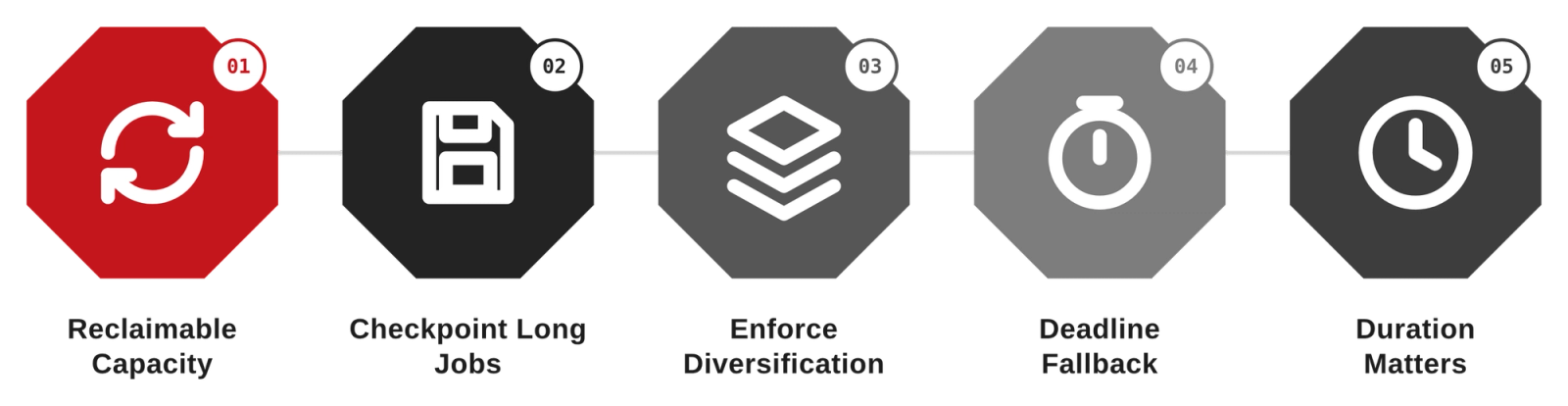
Spot instance strategy for energy means running interruption-tolerant workloads on reclaimable capacity, with checkpointing for long-running jobs, enforced diversification, and deadline-aware fallback, so savings do not cost a forecast window.
Why “Context” Is Becoming the New Cloud Infrastructure Layer
Understand how context infrastructure is reshaping retrieval and intelligent systems.
However, most adoptions treat batch as equivalent to interruptible, which holds for short jobs and fails for the long simulations that dominate energy compute.
If you are a VP of Engineering or Head of Infrastructure at an energy company, the intent of this article is:
- Define why job duration changes interruption tolerance
- Show how deadlines interact with reclamation risk
- Lay out where checkpointing makes spot viable
To do that, let's start with the basics.
What Is Spot Instance Strategy for Energy? The Basic Definition
At a high level, spot capacity is compute offered at a substantial discount in exchange for reclamation with short notice. In an energy estate the candidate workloads are modelling, simulation, forecasting, and analytical batch, which look ideal because no user is waiting.
The complication is duration. A job running for hours has a high cumulative probability of interruption, and without checkpointing an interruption means starting again, so the expected completion time can exceed the deadline even though each individual attempt was cheap.
Checkpointing converts a long job from a bet into a resumable process, which is what makes spot viable for this class of work.
To compare:
Running a nine hour simulation on spot without checkpointing is driving a long route in a car that might be recalled at any point, with no way to resume from where you stopped.
Each attempt is cheap and the journey may never complete. Adding the ability to continue from the last town changes the economics entirely, and it is the thing that has to be built rather than configured.
Why Does Spot Instance Strategy Matter for Energy?
Issues that it addresses or resolves:
- Long-running jobs restarting from the beginning after interruption
- Batch workloads assumed interruptible without checkpointing
- Forecast and reporting deadlines missed by repeated restarts
Resolved Issues by Spot Done Well
- Long jobs resuming from checkpoints rather than restarting
- Deadline risk assessed against interruption probability
- Savings taken without deadline exposure
Core Components of Spot Instance Strategy in Energy
- Interruption tolerance assessed against job duration
- Checkpointing for long-running workloads
- Instance type and zone diversification enforced
- Deadline-aware fallback to on-demand
- The OT boundary excluded from spot entirely
Modern Spot Tooling for Energy
- Capacity providers with enforced diversification
- Checkpointing frameworks for long-running jobs
- Interruption notice handling with checkpoint flush
- Deadline-aware scheduling with on-demand fallback
- Interruption rate and completion time monitoring
These tools make long jobs viable. Checkpointing with a flush on interruption notice is the component that turns duration from a risk into a manageable property.
Other Core Issues They Will Solve
- Modelling compute cost reduced substantially
- Deadlines met despite interruptions
- Completion time predictable rather than variable
In Summary: Spot instance strategy for energy works when long-running jobs checkpoint, because duration rather than batch nature determines interruption tolerance.
Importance of Spot Instance Strategy for Energy in 2026
Modelling and simulation compute is a large and growing cost. Four reasons explain why this matters now.
1. Energy compute skews long-running.
Simulation and modelling jobs run for hours, which changes the interruption arithmetic completely.
2. Cumulative interruption probability compounds with duration.
A short job rarely gets interrupted; a nine hour job frequently does.
3. Deadlines are real.
Forecast and reporting windows mean a job that eventually completes is not the same as one that completes in time.
4. Savings on modelling compute are material.
The footprint is large enough that the discount matters if the reliability question is solved.
Traditional vs. Modern Energy Spot Adoption
- On-demand for all modelling vs. spot with checkpointing
- Batch assumed interruptible vs. tolerance assessed by duration
- Restart on interruption vs. resume from checkpoint
- Deadlines hoped for vs. deadline-aware fallback
In summary: A modern energy approach makes long jobs resumable and schedules with awareness of deadlines and interruption probability.
Details About the Core Components of Spot Instance Strategy in Energy: What Are You Designing?
Let's go through each component.
1. Duration Layer
Tolerance by job length.
Duration decisions:
- Interruption probability estimated per job duration
- Short and long jobs treated differently
- Deadline exposure calculated
2. Checkpoint Layer
Making long jobs resumable.
Checkpoint decisions:
- Checkpoint frequency chosen against overhead
- Flush on interruption notice
- Resume path tested
3. Diversification Layer
Enforced spread.
Diversification decisions:
- Multiple instance types and zones required
- Actual placement monitored
- Concentration alerted
4. Deadline Layer
Scheduling with awareness.
Deadline decisions:
- Jobs with hard deadlines identified
- On-demand fallback triggered by deadline risk
- Completion time monitored
5. Boundary Layer
Where spot does not go.
Boundary decisions:
- Operational technology excluded entirely
- Operationally adjacent workloads assessed
- Boundary enforced in configuration
Benefits Gained from Spot Instance Strategy in Energy
- Modelling compute cost reduced substantially
- Long jobs completing despite interruptions
- Deadlines met through fallback rather than luck
How It All Works Together
The energy engineering team assesses interruption tolerance against job duration rather than against batch nature, because a two minute job and a nine hour job on identical infrastructure have completely different exposure.
Interruption probability is estimated per duration and deadline exposure calculated, which frequently shows that long jobs need checkpointing before spot is viable at all. Checkpointing is then implemented with a frequency chosen against its overhead, a flush triggered on interruption notice so the most recent state is preserved, and a resume path that has been tested rather than assumed.
Diversification is enforced across instance types and zones with actual placement monitored, since configured spread drifts toward the cheapest option. Jobs with hard deadlines are identified and scheduled with awareness, so an approaching forecast window triggers on-demand fallback rather than another spot attempt.
And anything touching operational technology is excluded from spot entirely, enforced in configuration.
Common Misconception
It is a batch job, so it tolerates interruption.
Batch describes who is waiting, not what happens when the job stops. A short batch job interrupted simply runs again and costs a few minutes. A nine hour simulation interrupted at hour seven without checkpointing loses seven hours, and since the cumulative probability of interruption over nine hours is considerably higher than over nine minutes, the expected number of attempts rises while the expected completion time rises faster.
The job may never finish inside its deadline while every individual attempt looks cheap. Duration is the variable that matters and batch nature is not, which is why the same spot configuration works for one workload and quietly fails a forecast window for another.
Key Takeaway: Batch describes who waits; duration determines interruption exposure. A long job without checkpointing may never complete in time.
Real-World Spot Instance Strategy for Energy in Action
Let's take a look at how it operates with a real-world example.
We worked with an energy engineering team whose nine hour simulations kept missing a forecast window, with these constraints:
- Assess tolerance against duration rather than batch nature
- Implement checkpointing with flush on interruption notice
- Trigger on-demand fallback on deadline risk
Step 1: Assess by Duration
Not by batch nature.
- Interruption probability per duration estimated
- Deadline exposure calculated
- Short and long jobs separated
Step 2: Implement Checkpointing
Make long jobs resumable.
- Frequency chosen against overhead
- Flush on interruption notice
- Resume path tested
Step 3: Enforce Diversification
And monitor placement.
- Multiple types and zones required
- Actual placement monitored
- Concentration alerted
Step 4: Schedule With Deadlines
Fallback on risk.
- Hard deadline jobs identified
- On-demand triggered by deadline risk
- Completion time monitored
Step 5: Exclude the Boundary
Absolutely.
- Operational technology excluded from spot
- Adjacent workloads assessed
- Exclusion in configuration
Where It Works Well
- Modelling and simulation with checkpointing implemented
- Short analytical batch without deadline pressure
- Estates enforcing diversification and monitoring placement
Where It Does Not Work Well
- Long jobs without checkpointing
- Hard deadlines with no on-demand fallback
- Anything touching operational technology
Key Takeaway: Checkpoint the long jobs, schedule with deadline awareness, enforce spread, and keep spot away from operational systems.
Common Pitfalls
i) Treating batch as interruptible
Duration determines exposure, and a long job without checkpointing loses everything on interruption. Assess by duration and implement checkpointing first.
- Nine hour jobs restart repeatedly
- The forecast window is missed
- Each individual attempt looked cheap
ii) Checkpointing without a tested resume
A checkpoint that has never been resumed from is a file rather than a capability. Test the resume path deliberately.
iii) No deadline awareness
A job approaching a hard window should fall back to on-demand rather than making another spot attempt. Identify deadline jobs and schedule accordingly.
iv) Diversification unmonitored
Configured spread drifts toward the cheapest type, so concentration appears without any configuration change. Monitor actual placement.
Takeaway from these lessons: For energy compute the decisive variable is job duration, and checkpointing is the enabling work.
Spot Best Practices for Energy: What High-Performing Teams Do Differently
1. Assess tolerance by duration
Estimate interruption probability against job length and calculate deadline exposure, because batch nature tells you nothing about this.
2. Implement checkpointing before migrating long jobs
Make resumption possible, with a flush on interruption notice and a tested resume path.
3. Schedule with deadline awareness
Trigger on-demand fallback when a hard window is at risk rather than attempting spot again.
4. Enforce diversification and monitor placement
Watch actual spread rather than configured spread, since drift toward the cheapest type is normal behaviour.
5. Exclude operational technology entirely
Keep spot capacity away from anything operationally adjacent, enforced in configuration.
Logiciel's value add is helping energy engineering teams make long-running modelling workloads viable on spot through checkpointing and deadline-aware scheduling.
Takeaway for High-Performing Teams: Assess by duration, checkpoint first, schedule for deadlines, monitor placement, exclude OT.
Signals You Are Doing Spot Instance Strategy Well in Energy
How do you know it is working? Not by savings, but by whether long jobs complete in their windows. These are the signals that separate viable spot from a missed deadline.
Long jobs resume. Checkpointing works and the resume path is tested.
Deadlines are met. On-demand fallback triggers on risk rather than after failure.
Placement is monitored. Actual spread is tracked, not just configured.
Completion time is predictable. Variability from interruption is bounded.
OT is excluded. No operationally adjacent workload runs on reclaimable capacity.
Adjacent Capabilities and Connected Work
This work does not exist in isolation. Spot strategy depends on, and feeds into, the surrounding platform. Ignoring the adjacencies is the most common scoping mistake.
FinOps guardrails supply the cost context and provisioning discipline. Streaming and batch decisions determine which workloads exist. Cloud waste work identifies idle modelling capacity. Warehouse cost work shares the deadline sensitivity. Naming these adjacencies upfront keeps the work scoped and helps leadership see checkpointing as the enabling investment.
The common mistake is treating each adjacency as someone else's problem. The checkpointing implementation is your problem. The deadline scheduling is your problem. The placement monitoring is your problem. Pretend otherwise and a forecast window will be missed by a job that kept restarting.
Own the adjacencies you depend on, partner with the teams that hold them, and share the deadlines.
Conclusion
Energy compute skews toward long-running modelling and simulation, which makes duration rather than batch nature the variable that determines whether spot is viable. A nine hour job has a materially higher cumulative interruption probability than a nine minute one, and without checkpointing an interruption at hour seven loses seven hours, so expected completion time can exceed a deadline while every individual attempt looks cheap.
Implement checkpointing with a flush on interruption notice and a tested resume path before migrating long jobs, schedule with awareness of hard deadlines so risk triggers on-demand fallback, enforce diversification and monitor actual placement, and keep spot capacity away from operational technology.
Key Takeaways:
- Duration, not batch nature, determines interruption exposure
- Long jobs need tested checkpointing before spot becomes viable
- Deadline-aware scheduling is what prevents savings costing a forecast window
Running spot well in energy requires checkpointing first. When done correctly, it produces:
- Modelling compute cost reduced substantially
- Long jobs completing despite interruptions
The AI Product Playbook: Launch Faster, Scale Smarter, Fund with Confidence
Launch faster, scale smarter, and approach funding with greater confidence.
- Deadlines met through fallback rather than luck
- Predictable completion times
What Logiciel Does Here
If your long simulations keep restarting and missing windows, we help you implement checkpointing, add deadline-aware fallback, and enforce diversification properly.
Learn More Here:
- FinOps Guardrails for Energy
- Streaming vs Batch for Energy
- Cloud Waste for Energy
At Logiciel Solutions, we work with energy engineering leaders on compute cost. Our reference patterns come from estates running long modelling workloads.
Book a technical deep-dive on making long-running jobs viable on reclaimable capacity.