
An energy company's platform team writes Terraform modules for the teams building grid analytics, outage management, and field systems. Each module starts clean. Two years later they carry dozens of inputs, most added because one team needed one override once, and half the compliance controls are optional variables that some callers set and some do not. When an auditor asks whether logging is enabled on every environment, the answer requires reading thirty state files. The controls were written. They were just made optional, and optional controls in a regulated estate are the same as absent controls with extra paperwork.
A module is where standards actually get applied. Making them optional is how you lose them.
Terraform modules for energy means designing reusable infrastructure components with a narrow interface, compliance controls encoded as non-negotiable defaults, honest versioning, and a named owner, so engineering teams provision consistently and evidence comes from configuration rather than investigation.
However, most teams grow modules by adding a variable whenever someone asks, and end up with an interface too wide to change and controls too optional to evidence.
If you are a VP of Platform Engineering or Head of Developer Experience at an energy company, the intent of this article is:
- Define a module as an interface where controls live, not a config container
- Show why optional compliance settings fail in a regulated estate
- Lay out how to design, version, and own modules teams can consume safely
To do that, let's start with the basics.
Agentic AI for Real Estate Operations: An Executive Blueprint.
The technology to automate a third of your operations already works. The hard part is that most firms buy it and watch it stall within 90 days. This blueprint is about landing on the right side of that gap.
What Are Terraform Modules for Energy? The Basic Definition
At a high level, a Terraform module in an energy org is a reusable unit of infrastructure with a defined input interface, a defined output contract, and an owner responsible for both. In a regulated environment it is also the most reliable place to put your controls, because a control encoded in a default is applied every time while a control described in a standards document is applied when someone remembers. A well-designed module exposes the small number of choices a caller genuinely needs, encodes tagging, encryption, logging, retention, and network placement as defaults, and produces infrastructure that is compliant on creation rather than remediated afterwards.
To compare:
A well-designed module is a light switch. You choose on or off; you do not choose the wire gauge, and you certainly do not choose whether the circuit is earthed. A badly designed module exposes every wire and includes earthing as an optional parameter. Both technically deliver electricity. Only one produces an installation you can certify. The narrowness of the interface, and the non-negotiability of the defaults, are what make a module useful in an environment where someone will eventually ask for evidence.
Why Are Well-Designed Modules Necessary for Energy?
Issues that it addresses or resolves:
- Each team writing slightly different infrastructure for the same purpose
- Compliance controls exposed as optional variables that some callers skip
- Evidence gathered by investigation rather than read from configuration
Resolved Issues by Well-Designed Modules
- Consistent infrastructure across teams without central review
- Controls applied automatically because they are not optional
- Evidence produced from module configuration rather than assembled by hand
Core Components of Terraform Modules in Energy
- A narrow input interface exposing only genuine choices
- Compliance controls encoded as non-negotiable defaults
- Outputs designed for composition by callers
- Semantic versioning with a published deprecation policy
- A named owning team and documented support model
Modern Terraform Module Tooling for Energy
- A private module registry with versioned releases
- Automated testing against real providers, including upgrade paths
- Policy as code validating plans even where overrides are permitted
- Documentation generated from the interface itself
- Consumer visibility showing who runs which version
These tools make modules maintainable and evidenceable. Versioning, testing, and consumer visibility are what let you change a module the whole estate depends on without a coordination exercise every time.
Other Core Issues They Will Solve
- Engineers provision infrastructure without learning provider details
- Controls apply automatically because they live in the defaults
- Platform improvements roll out through version bumps rather than migrations
In Summary: Terraform modules for energy are versioned interfaces with narrow inputs and mandatory control defaults, so teams provision consistent, compliant infrastructure and the platform team retains the ability to change things.
Importance of Module Design for Energy in 2026
Energy estates are large, long-lived, and audited. Four reasons explain why module design matters now.
1. Modules are where controls actually land.
A control in a document is applied sometimes. A control in a default is applied always, which is the difference between a policy and an outcome.
2. Evidence should be a read, not an investigation.
If proving a control requires inspecting state files across teams, your audit cycle is expensive by design.
3. Wide interfaces freeze.
Every exposed variable is a promise, and across a long-lived estate you cannot break promises without a migration project.
4. Infrastructure outlives its authors.
Energy systems run for years. A module with no owner becomes a dependency nobody can safely upgrade.
Traditional vs. Modern Energy Infrastructure Reuse
- Copied configuration between teams vs. versioned shared modules
- Compliance as optional variables vs. controls encoded as defaults
- Standards in a document vs. standards in the code teams run
- Unversioned shared code vs. semantic versioning with deprecation
In summary: A modern energy approach treats modules as versioned interfaces where controls are mandatory, rather than as shared configuration everyone edits around.
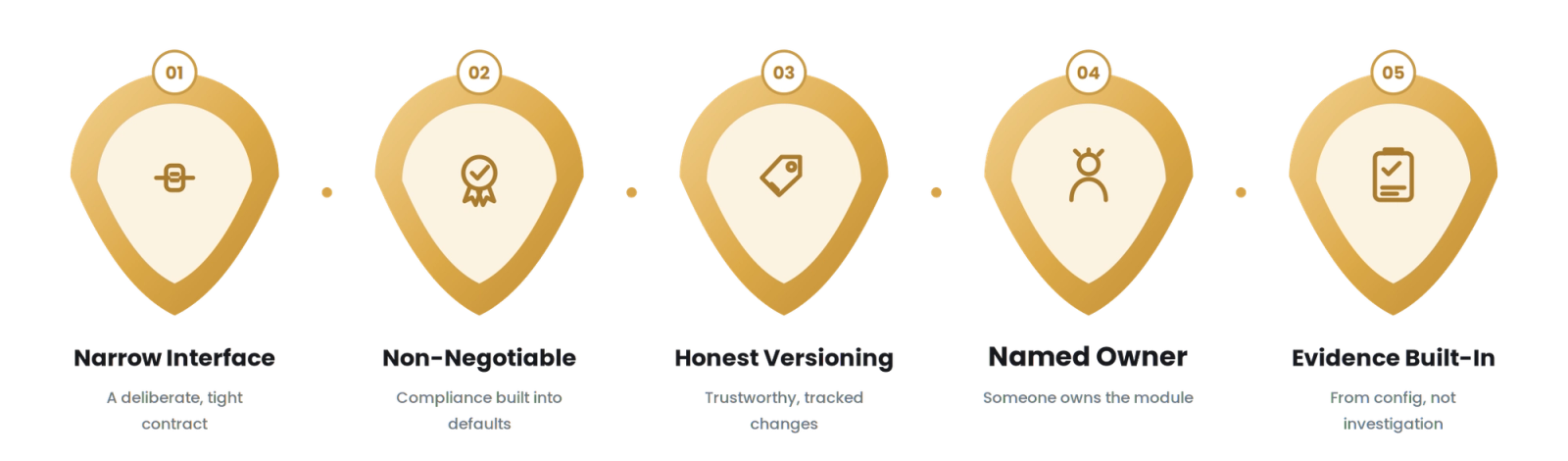
Details About the Core Components of Terraform Modules in Energy: What Are You Designing?
Let's go through each component.
1. Interface Layer
The inputs.
Interface decisions:
- Only genuine choices exposed as variables
- Provider detail hidden behind defaults
- Every new input treated as a permanent commitment
2. Controls Layer
Non-negotiable defaults.
Controls decisions:
- Encryption, logging, tagging, and retention always on
- Compliance settings not exposed as optional
- Network placement constrained by the module
3. Output Layer
What callers get.
Output decisions:
- Outputs designed for composition, not debugging
- Stable across versions where possible
- Internal implementation not leaked
4. Versioning Layer
Change management.
Versioning decisions:
- Semantic versioning applied honestly
- Breaking changes signalled and scheduled
- Deprecation windows published in advance
5. Ownership Layer
Who maintains it.
Ownership decisions:
- A named owning team with a support model
- Consumer and version list visible to the owner
- Testing and release process defined
Benefits Gained from Well-Designed Modules in Energy
- Consistent, compliant infrastructure across teams without gatekeeping
- Controls applied at creation rather than remediated later
- Evidence produced from configuration rather than investigation
How It All Works Together
The energy platform team designs each module around the decisions an engineering team genuinely needs to make, which is a shorter list than it first appears. Everything else, encryption, logging destinations, retention periods, tagging for cost and ownership, network placement relative to trust zones, becomes a default that reflects the org's control standards. Crucially, the compliance-relevant defaults are not exposed as optional variables, because an optional control is one someone will eventually skip under deadline pressure and nobody will notice until an audit. Outputs are designed for composition, exposing what callers need to wire things together without leaking internals that would lock the implementation. The module is published to a private registry with semantic versioning applied honestly, so teams pin a version and the platform team ships improvements without surprising anyone mid-quarter. Automated tests exercise the module against real providers including upgrade paths, because a module the estate depends on cannot be validated by review alone. The owning team can see who runs which version, so a control change becomes a scheduled conversation with a known list rather than a broadcast. Evidence for an audit then comes from reading module versions and defaults rather than from inspecting individual environments.
Common Misconception
Compliance settings should be configurable so teams can adapt them to their situation.
That sounds accommodating and it is how controls quietly disappear. Once encryption or log retention is a variable, some callers will set it correctly, some will copy an older example, and one will disable it during a deadline with every intention of restoring it later. Nobody notices, because there is no single place that shows the state of the control across the estate. When the audit question comes, the answer requires an investigation rather than a lookup, and the finding is not that a control was missing but that the control was never enforced. Real variation exists and should be handled deliberately, through a separate module variant with its own justification and its own owner, not through an optional flag on the standard one. Make the compliant path the only easy path.
Key Takeaway: An optional control is an absent control with extra paperwork. Encode compliance as defaults you cannot switch off casually.
Real-World Terraform Modules for Energy in Action
Let's take a look at how it operates with a real-world example.
We worked with an energy platform team whose modules had dozens of inputs and optional compliance flags, with these constraints:
- Narrow the interface to genuine choices
- Make compliance controls non-negotiable defaults
- Version and own modules so evidence stays consistent
Step 1: Narrow the Interface
Genuine choices only.
- Inputs reduced to real decisions
- Provider detail hidden behind defaults
- New inputs treated as commitments
Step 2: Fix the Controls
Not optional.
- Encryption, logging, and retention always on
- Compliance settings removed from the interface
- Variants used for genuine exceptions
Step 3: Design the Outputs
For composition.
- Outputs support wiring, not debugging
- Stability preserved across versions
- Implementation not leaked
Step 4: Version Honestly
Semantic versioning.
- Breaking changes signalled and scheduled
- Deprecation windows published
- Consumers able to pin versions
Step 5: Own and Test It
A real product.
- Named owning team and support model
- Automated tests against real providers
- Consumer and version list maintained
Where It Works Well
- Infrastructure patterns many teams need in nearly the same shape
- Estates where controls must be evidenced consistently
- Platform teams willing to hold an opinion and defend it
Where It Does Not Work Well
- Genuinely unique infrastructure used by a single team
- Modules with no owner or no versioning discipline
- Orgs where compliance flags are granted as configuration options
Key Takeaway: Modules pay off in energy when the interface is narrow and controls are mandatory; they fail when compliance becomes a variable.
Common Pitfalls
i) Making controls configurable
Exposing encryption, logging, or retention as inputs means some environments will lack them and nobody will know until an audit. Encode them as defaults and handle real exceptions through a separate, justified variant.
- Controls applied inconsistently across the estate
- Evidence requires investigation rather than a lookup
- Findings cite enforcement, not just the gap
ii) Growing the interface by request
Each new variable seems reasonable alone, and the cumulative result is a module nobody can change. Ask what the requester is trying to achieve, because the answer often points at a missing default.
iii) No versioning discipline
Without semantic versioning, every consumer tracks the main branch and every improvement is a potential incident. Version properly and let teams pin deliberately.
iv) No owner
An unowned module in a long-lived estate becomes a dependency nobody dares upgrade, which is worse than the duplication it replaced. Name a team and publish a support model.
Takeaway from these lessons: Modules succeed when interfaces are narrow, controls are mandatory, versions are honest, and ownership is real.
Terraform Module Best Practices for Energy: What High-Performing Teams Do Differently
1. Put controls in the defaults, not the interface
Encryption, logging, retention, and tagging should be automatic, because a control someone can skip is a control someone will skip.
2. Design the interface for the caller
Expose the decisions an engineering team genuinely needs and hide everything else, so callers do not need provider expertise to be compliant.
3. Handle exceptions as variants
When a genuine exception exists, publish a separate module variant with a documented justification and owner rather than adding a flag to the standard one.
4. Version and test honestly
Apply semantic versioning, publish deprecation windows, and test upgrade paths against real providers so teams move deliberately.
5. Know your consumers
Track who runs which version, so a control change is a scheduled conversation with a known list rather than a broadcast and a hope.
Logiciel's value add is helping energy platform teams design module interfaces narrow enough to evolve and opinionated enough to carry controls, so compliance is applied at creation and evidence comes from configuration.
Takeaway for High-Performing Teams: Encode controls as mandatory defaults, keep interfaces narrow, version honestly, and treat exceptions as separate variants rather than flags.
Signals You Are Doing Modules Well in Energy
How do you know it is working? Not by how many modules exist, but by whether controls are consistent and modules can still change. These are the signals that separate an interface from a config container.
The interface is short. Callers make a handful of decisions, not dozens.
Controls are automatic. Encryption, logging, and retention cannot be skipped casually.
Evidence is a lookup. Proving a control means reading module versions, not inspecting environments.
Versions are pinned. Consumers choose when to upgrade rather than tracking main.
Ownership is clear. A named team responds within a stated window.
Adjacent Capabilities and Connected Work
This work does not exist in isolation. Module design depends on, and feeds into, the surrounding platform. Ignoring the adjacencies is the most common scoping mistake.
Policy as code validates plans even where variants are permitted. Golden paths determine which modules teams reach for. Self-service infrastructure is what consumes them. Your private registry makes versioning real, and your audit process consumes the evidence they produce. Naming these adjacencies upfront keeps the work scoped and helps leadership see modules as where controls live rather than as shared utility code.
The common mistake is treating each adjacency as someone else's problem. The control defaults are your problem. The version discipline is your problem. The evidence trail is your problem. Pretend otherwise and controls drift while everyone assumes someone else is checking. Own the adjacencies you depend on, partner with the teams that hold them, and share the standards.
Conclusion
In an energy estate, the Terraform module is where your controls actually get applied. Encode encryption, logging, retention, and tagging as defaults that cannot be casually disabled, expose only the decisions a team genuinely needs to make, and handle real exceptions as separate justified variants rather than optional flags on the standard module. Version honestly so teams pin and upgrade deliberately, test upgrade paths against real providers, and name an owning team that knows its consumers. Do that and audit evidence becomes a lookup. Leave compliance as a variable and you will spend every audit cycle reconstructing what should have been guaranteed.
How a Healthcare Provider Modernized DevOps for Regulated Workloads.
Standard changes that used to take weeks now ship in hours, and compliance signs off on the pipeline itself. This whitepaper shows the redesign: controls that live in code, audit evidence that generates itself, and changes classified by real risk.
Key Takeaways:
- A module is where controls live, not a place to put configuration
- Optional compliance settings are absent controls with extra paperwork
- Narrow, versioned interfaces stay changeable across a long-lived estate
Designing modules well requires holding an opinion. When done correctly, it produces:
- Consistent, compliant infrastructure across teams
- Controls applied at creation rather than remediated later
- Evidence read from configuration rather than investigated
- Modules that can still be changed years after launch
What Logiciel Does Here
If your modules expose compliance as optional variables, we help you move controls into mandatory defaults, narrow the interface, and put versioning and ownership behind it.
Learn More Here:
- Policy as Code for Energy
- Golden Paths and Self-Service Infrastructure
- Secrets Management and Infrastructure Standards
At Logiciel Solutions, we work with energy platform leaders on infrastructure as code design. Our reference patterns come from module libraries running in regulated estates.
Book a technical deep-dive on making compliance automatic in your module library.