The salary line is the part everyone quotes. It's also the part that misleads you most. If you're deciding between hiring your own AI team and bringing in an implementation partner, the comparison you've probably seen is salaries versus an agency rate.
Build in-house when AI is your core product and you'll be shipping models for years. Hire a partner when you need production AI soon, can't yet justify a permanent senior team, or your own team has never taken a model to production before. Most companies need both over time, just not at the same time.
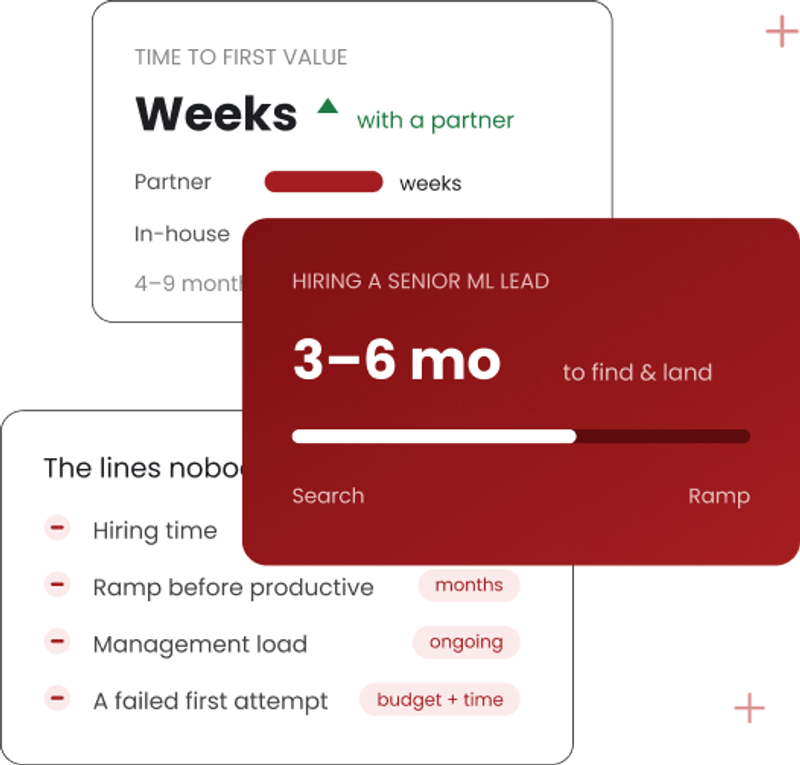
The sticker comparison looks clean: a few engineer salaries versus a partner's monthly cost. Then reality adds the lines nobody put in the spreadsheet.
What You’ll Learn Inside
A senior ML engineer or platform lead can take 3 to 6 months to find and land in this market , and that's time your initiative isn't moving.
Gives the model your knowledge at answer time. Retrieve the relevant documents and hand them over so it answers from your truth, not its training. Right when the model needs facts specific to your business, especially ones that change.
The management load of a new AI team falls on you and your leads.
First AI projects fail not because the idea was bad, but because nobody had shipped production AI before , lessons learned on your budget and your timeline.
What each path really costs , beyond the salary line.
| Cost / factor | Build in-house | Hire a partner |
|---|---|---|
| Time to first value | 4–9 months (hire, ramp, first ship) | Weeks to first working output |
| Senior talent | You compete for it in a tight market | Already on the team, day one |
| Cost shape | Fixed: salaries, benefits, equity, ongoing | Variable: scoped to the work, scales down when done |
| Risk of a failed first project | Higher: learning on your time and budget | Lower: patterns proven on prior builds |
| Management overhead | Falls on you and your leads | Engagement lead carries it |
| Long-term ownership | Full, in-house from the start | Transfers to you as part of the engagement |
| Best when | AI is your core product, multi-year roadmap | You need production AI soon, or to de-risk the first build |
We're not going to pretend a partner is always the answer. Build when:
If AI is core to your product and requires years of development, an in-house team is more cost-effective long term.
If you already have senior people who've shipped production AI, you may not need outside help at all.
Some teams simply prefer to keep all capability internal, which is a legitimate strategic choice.
What we'd push back on is building in-house for the wrong reason: doing it because hiring feels safer, while a six-month hiring cycle quietly becomes the most expensive line in the whole budget.
When teams work with us, the model is built to avoid the usual fear of an outside vendor. We embed senior engineers as an extension of your team, you keep the code and the architecture, and we transfer the capability so you're stronger when we leave, not dependent. A first engagement is scoped to prove value fast, before you commit to more.
Per month, often yes. Per outcome, usually no, once you count hiring time, ramp, management load, and the cost of a failed first attempt. That's the number the worksheet below actually compares.
That's the most common path. Use a partner to ship the first production AI and prove the value, then hire against a roadmap you've de-risked, with patterns the partner helped establish.
Then a partner can fill the gap now while your hires land and ramp, so the initiative doesn't stall for two quarters waiting on headcount.
Bring your actual numbers. We'll walk through a real total-cost-of-ownership comparison for your situation, including an honest read on whether building in-house is the better call.