
Zeme · Real Estate
Real Estate
Most data ingestion tools price you on volume - which means the more value you generate, the more you pay. Logiciel charges per active connector, not per row, and includes CDC, streaming, and batch in the same product. Same pipelines, same observability, same predictable bill.
The Fivetran bill has doubled because traffic from one source spiked. Per-row pricing means your bill grows when your business succeeds - exactly the wrong incentive structure for a foundational data tool.
You're maintaining custom connectors for 6 sources because the SaaS vendor doesn't support them. Custom connector maintenance is a hidden recurring cost that doesn't appear on any line item but consumes 5-15% of data engineering capacity.
until someone runs a backfill and the bill comes for $40K. Unbounded backfill costs create career-ending procurement surprises; the right product caps cost without capping capability.
50-500 connector portfolios need pricing that scales with operational complexity, not with data volume.
Streaming, batch, and CDC in one tool eliminate the integration tax of stitching three vendors with three SLAs and three oncall rotations.
Ingestion that scales with your data, not against it.
SaaS, files, APIs, queues. 200+ pre-built connectors mean 90% of typical data sources are running in minutes, not days
not punishing. Per-connector pricing aligns the bill with the operational reality, not with the volume of data flowing through - predictable at scale
volume, schema drift on every connector. Built-in observability means schema drift, freshness lag, and anomaly detection apply to every connector without additional configuration
| Dedicated Pod | Staff Augmentation | Project-Based Delivery |
|---|---|---|
| Embedded data engineering pod aligned to your sprint cadence - typically 3–6 engineers + a US lead. | Senior data engineers, architects, and SMEs slotted into your team to unblock specific work. | Fixed-scope, milestone-driven engagements with clear deliverables and outcomes. |
We map your stack, workloads, team, and constraints in a working session - not an RFP response.
Reference architecture grounded in your reality, with capacity, cost, and migration plans.
Iterative implementation with weekly demos, code reviews, and your team in the loop.
Managed operations or knowledge transfer - your choice. Both with US-aligned coverage.
Continuous tuning of cost, performance, and reliability against measurable SLAs.
CDC from Postgres, MySQL, MongoDB, SQL Server, Oracle, and 30+ more.
Kafka, Kinesis, Pub/Sub with exactly-once semantics.
Open SDK in Python or Go. CI-friendly. Versioned.
Salesforce, HubSpot, Marketo, Zendesk, Stripe, NetSuite, Workday, and 150+.
S3, GCS, ADLS, REST, GraphQL, gRPC ingestion.
Idempotent, schedulable, cost-bounded backfills.


Teams that needed to ship fast, and did. Here's what partnering with Logiciel felt like from the inside.

I would highly recommend them to anyone looking to scale quickly or needing support in engineering, product, or QA.
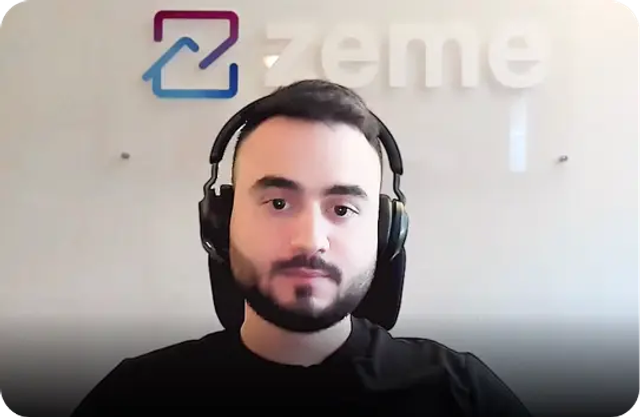
We don't just call them Logiciel; they're part of the Zeme team. Within the first week they were contributing meaningfully to our codebase.

The Logiciel team worked tirelessly and built everything we needed, with security and best practices across our entire platform. It allowed us to become #1 in our industry, and we couldn't have done it without them.

Per-connector pricing typically saves 30-60% at scale, especially for teams with high-volume sources where Fivetran's per-row model gets punishing. Concrete example: a marketplace with 100M Salesforce events and 50M Stripe events per month often pays $15-25K monthly to Fivetran.
The same workload on Logiciel runs $4-8K monthly per-connector. Airbyte OSS is free but operationally expensive (you run it); Airbyte Cloud is per-row similar to Fivetran. Logiciel's per-connector model means your bill grows with the number of distinct sources, not with how successful your business is. We benchmark TCO against your actual Fivetran/Airbyte invoices at evaluation.
Yes - using our open Python or Go SDK with full local testing, CI integration, and a standard development cycle (write, test, code-review, deploy). Custom connectors get the same observability, retry logic, schema evolution, and governance contract as platform-managed connectors.
Common cases: niche industry SaaS (vertical CRM, EHR systems, construction software), internal APIs, partner data exchanges, and custom CDC patterns for legacy databases. Most customers ship a working custom connector in 1-2 sprints.
Connectors are versioned in your own Git repo, not locked into Logiciel's catalog, so you maintain ownership of the code regardless of vendor relationship.
Yes - natively for Postgres, MySQL, MongoDB, SQL Server, Oracle, MariaDB, DB2, Cassandra, and 30+ databases, with sub-minute end-to-end latency. We use log-based CDC where the database supports it (Postgres logical replication, MySQL binlog, SQL Server CDC, Oracle LogMiner) and trigger-based CDC as fallback.
Schema evolution is handled automatically with policy-driven routing (auto-evolve, alert, or block). Backfills are idempotent and bounded - no surprise multi-thousand-dollar backfill bills. CDC is included in standard pricing tiers, not a separate SKU.
For US FinTech and regulated customers, exactly-once CDC is critical and we pass independent audits on the guarantee.
Snowflake, Databricks, BigQuery, Redshift, S3, ADLS, GCS, Postgres, MySQL, MongoDB, Iceberg tables, Delta tables, Hudi tables, plus 100+ reverse-ETL destinations (Salesforce, HubSpot, Marketo, Iterable, Customer.io, Braze, Zendesk, etc.) - all included in per-connector pricing without per-destination fees.
The 'Hightouch tax' (paying separately for activation/reverse-ETL on top of ingestion) is eliminated. Custom destinations follow the same SDK pattern as custom sources. For multi-cloud customers, we support fan-out to multiple destinations from a single ingestion pipeline, including cross-cloud and cross-region with residency controls.
Auto-detect, classify, and route to a schema policy: auto-evolve (additive changes like new columns), alert (potentially breaking changes like type widening), or block (destructive changes like dropped columns). Policies are defined per-pipeline or per-source, versioned in Git, and enforced at runtime.
Schema drift events generate lineage-aware alerts so the upstream owner and downstream consumers all know simultaneously. For dbt-heavy stacks, schema evolution flows naturally into dbt model adjustments, with optional CI integration that blocks dbt deploys until schema changes are reviewed.
Most customers eliminate the 'who changed the source schema and broke prod' fire drill within a month of adoption.
Yes - self-hosted control plane available for regulated industries (financial services with SOX/GLBA, healthcare with HIPAA, government-adjacent with FedRAMP), with the data plane running fully in your VPC. Customer-managed encryption keys via AWS KMS, Azure Key Vault, or GCP Cloud KMS.
Optional fully air-gapped deployment for the most sensitive workloads, with isolated update channels. SCIM, SSO, and audit logging integrate with your existing IAM and SIEM. We've supported FedRAMP-aligned and HIPAA-aligned in-VPC deployments at Fortune 500 scale.
The in-VPC option is priced 30-50% above SaaS to reflect the additional support overhead, but the trade-off is acceptable for regulated buyers.
Most teams ingest their first source in under 30 minutes - connect a database or SaaS source, choose a destination, and Logiciel handles credentials, schema discovery, initial sync, and ongoing CDC automatically.
Day one onboarding typically gets 5-10 sources running. By day 7, most customers have 20-50 sources operational with observability and schema policies configured. Full migration from a homegrown setup or competitor (Fivetran + Hightouch combined) typically takes 6-12 weeks for 100-200 connectors.
The longest pole is usually credential management and source-system access requests, not Logiciel configuration. Implementation is fixed-fee with named US-time-zone engineers embedded in your sprint.
Sign up, connect 5 sources, and see them flowing into your warehouse - free for 30 days, no credit card.