
Zeme · Real Estate
Real Estate
Computer vision development services for healthcare imaging, visual inspection, workflow automation, and custom AI software with secure system integration.
We combine computer vision development, AI engineering, data pipelines, application integration, and evaluation to turn visual data into dependable healthcare software capabilities.
focused on specific users, visual tasks, operational friction, available data, and measurable outcomes
designed around your image types, environments, labels, workflows, and accuracy requirements
for ingestion, preprocessing, annotation, storage, transformation, and model-ready datasets
across imaging platforms, applications, databases, APIs, cloud environments, and internal software
for cases where AI should assist review, flag uncertainty, or escalate decisions to qualified users
covering accuracy, confidence, failure cases, latency, drift, and production behavior
that can evolve as data sources, devices, workflows, and model requirements change
A cross-functional team works with your product and engineering organization across use-case design, data preparation, model development, integration, testing, and rollout.
Computer vision developers, AI engineers, and software specialists strengthen your existing team across model development, data pipelines, deployment, and evaluation.
A focused initiative built around a defined imaging, inspection, classification, monitoring, or visual automation use case with clear implementation objectives.
We assess the workflow, image sources, available data, accuracy requirements, user needs, risk areas, and whether computer vision is suitable for the problem.
We design pipelines for image collection, cleaning, transformation, labeling, annotation quality, dataset versioning, and training-data readiness.
We develop and evaluate models for classification, detection, segmentation, tracking, OCR, or other visual tasks based on the use case.
We connect vision capabilities with APIs, databases, cloud environments, imaging systems, internal applications, and existing product workflows.
We design confidence thresholds, review queues, escalation paths, approval steps, and interfaces for workflows where people remain responsible for decisions.
We test accuracy, sensitivity to image variation, failure cases, latency, model robustness, and workflow-specific performance before production use.
We monitor inference quality, failures, drift, processing speed, infrastructure usage, and cost so the system can improve after launch.
A practical framework for ranking opportunities by workflow value, image availability, labeling effort, model feasibility, operational complexity, and risk.
A structured way to decide when computer vision should automate, assist, prioritize, measure, or simply prepare information for human review.
A framework for dataset quality, evaluation, confidence thresholds, monitoring, drift detection, traceability, and human oversight.
We identify the visual task, users, available image or video data, existing systems, accuracy expectations, operational constraints, and the outcome the solution should improve.
We assess image quality, volume, diversity, labels, annotation requirements, permissions, storage, and whether the dataset is representative enough for development.
We define the vision approach, data pipeline, model architecture, inference environment, integrations, human-review controls, evaluation criteria, and deployment strategy.
We develop the computer vision software, connect required systems, test representative scenarios, analyze failure cases, and validate workflow performance.
We monitor production quality, latency, drift, failures, infrastructure usage, and user feedback while improving the system as new evidence becomes available.
Teams that needed to ship fast, and did. Here's what partnering with Logiciel felt like from the inside.

I would highly recommend them to anyone looking to scale quickly or needing support in engineering, product, or QA.
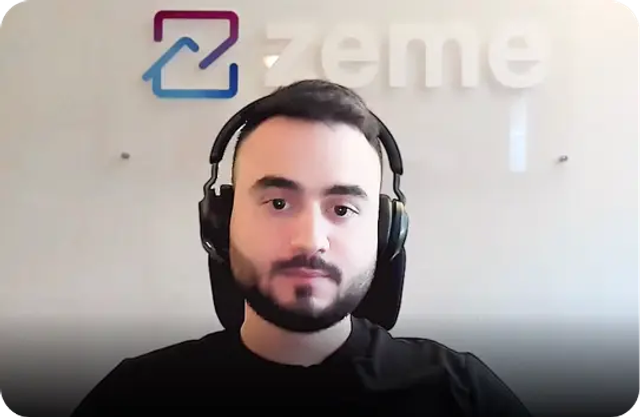
We don't just call them Logiciel; they're part of the Zeme team. Within the first week they were contributing meaningfully to our codebase.

The Logiciel team worked tirelessly and built everything we needed, with security and best practices across our entire platform. It allowed us to become #1 in our industry, and we couldn't have done it without them.

Computer vision development services for healthcare involve building software that can process and interpret images or video for defined healthcare workflows. Use cases may include classification, segmentation, detection, visual inspection, image-based document processing, and AI-assisted review.
We can support custom computer vision software for medical imaging workflows, visual inspection, document image processing, patient monitoring use cases, image classification, segmentation, video analytics, and embedded visual AI features.
Yes. Computer vision can support defined medical imaging workflows such as segmentation, measurement, classification, prioritization, or visual pattern detection. Higher-impact clinical interpretation should be designed with appropriate validation, controls, and qualified human review.
Yes. Custom computer vision software development can include data preparation, model development, APIs, user interfaces, system integration, deployment, monitoring, and workflow-specific controls rather than delivering only a standalone model.
The amount depends on the visual task, image variability, model approach, required performance, class balance, and quality of annotations. We assess available data before recommending a development approach rather than relying on a fixed dataset-size rule.
Yes. Depending on architecture and available interfaces, computer vision software can integrate with imaging systems, cloud platforms, databases, APIs, mobile applications, SaaS products, and internal healthcare applications.
Evaluation is specific to the use case. It can include task-level accuracy, precision, recall, segmentation quality, false-positive and false-negative patterns, robustness across image conditions, latency, confidence behavior, and performance on representative real-world data.
Build custom computer vision capabilities around real images, real workflows, and real system constraints with the evaluation and human controls needed for production use.